
Tides are the regular rise and fall of the sea's surface that we see along coastlines or when checking the surf for a few hours.
Every day, most places on Earth experience two high tides and two low tides in a roughly 24-hour and 50-minute cycle.
The phenomenon happens because the Moon's gravity pulls on Earth's oceans as Earth rotates. The Sun's gravity also plays a part, despite a slightly weaker one.
That extra 50 minutes comes from the time it takes the Moon to move a little farther along in its orbit around Earth.
Spring tides: when the ocean swings wide
A spring tide happens when the Earth, the Moon, and the Sun line up in a straight imaginary line.
The alignment takes place during the New Moon and the Full Moon phases.
At those times, the gravitational pull of the Moon and the Sun work together, and their combined force stretches the ocean's tidal bulges to their largest size.
The result is the greatest difference between high tide and low tide. The difference is called the tidal range.
During a spring tide, high tides are higher than average, and low tides are lower than average. In other words, everything's extreme.
You may wonder about the choice of terms.
The word "spring" does not refer to the season. It comes from an old English word that means to leap or to rise suddenly.
Spring tides occur about twice each lunar month.
The Moon's full cycle of phases lasts about 29.5 days, so we usually see two periods of especially large tidal range in that time.
If a full or new moon happens when the Moon is also near its closest point to Earth, called perigee, the tides can be even higher.
These are often called perigean spring tides, and in some regions, people refer to them as king tides.

Neap tides: when the ocean calms down
About one week after a spring tide, the tidal pattern shifts.
During the first quarter and third quarter phases of the Moon, the Sun and Moon are positioned at right angles relative to Earth.
In this arrangement, their gravitational pulls partly cancel each other out.
Consequently, the tidal bulges are smaller, and the tidal range is at its minimum.
High tides are not as high, and low tides are not as low. These are called neap tides.
They also happen about twice each lunar month, roughly seven days after each spring tide.
The cycle from spring to neap and back again follows the steady motion of the Moon around Earth.
It is one of the most predictable natural rhythms on the planet and allows surfers to plan their sessions ahead, as many times, their go-to surf breaks change dramatically with both spring and neap tides.

The tidal Rule of Twelfths
Now, tides do not rise and fall at a constant speed.
Interestingly, the water tends to move more slowly at the beginning and end of a tidal cycle and faster in the middle.
Therefore, sailors developed a simple method to estimate how the water level changes between high tide and low tide. It is called the Rule of Twelfths.
In places with regular semi-diurnal tides, meaning two highs and two lows each day, the time between a high tide and the next low tide is about six hours.
The rule divides the total tidal range into twelve equal parts.
Over the six-hour period, the water level changes in a pattern of 1, 2, 3, 3, 2, and 1 twelfths of the total range for each successive hour.
It's a pattern that reflects the way the tide speeds up toward the middle of the cycle and slows down near the turning points.
But does this have an impact on spring and neap tides?
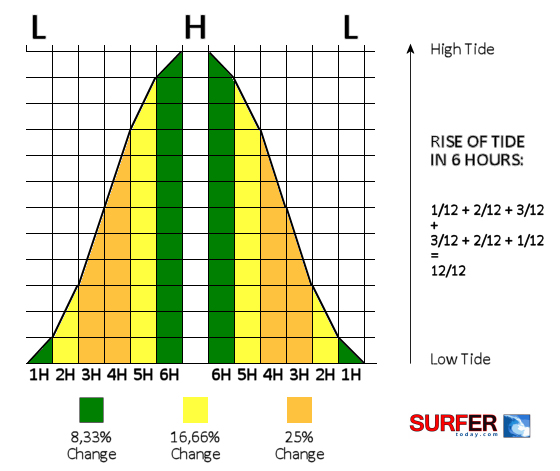
How spring and neap tides shape the Rule of Twelfths
Spring and neap tides do not change the shape of the rule of twelfths pattern, but they change the size of the numbers involved.
During a spring tide, the total tidal range is large. When you divide that larger range into twelve parts, each twelfth represents a greater vertical distance.
That means the rise or fall in the third and fourth hours, when three twelfths occur each hour, can be dramatic.
Currents are often stronger because more water is moving in or out over the same period of time.
During a neap tide, the total tidal range is smaller. Dividing that smaller range into twelve parts produces smaller changes each hour.
The pattern of 1, 2, 3, 3, 2, and 1 still applies as a rough estimate, but the actual change in depth is more modest.
For surfers, sailors, coastal planners, and even meteorologists, it's a difference that matters.
A spring tide can expose more of the shoreline at low water and flood higher up the beach at high water. A neap tide keeps the ocean's daily movement within a tighter band.
Knowing all these behaviors can help plan activities in the ocean and, for instance, protect our coastlines during extreme weather events.
Words by Luís MP | Founder of SurferToday.com
por Surfing | News, Headlines and Top Stories https://ift.tt/7gOMoiv