
One of the things people love about Portland is that it's two hours from the coast and two hours from skiable mountains. What if we drew the coast closer?
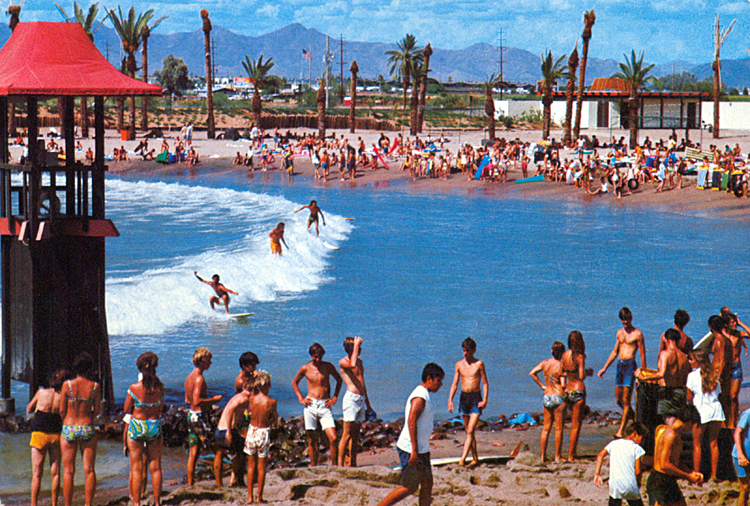
In the late 1960s, my dad played a small role in the construction of the first artificial wave pool in the United States: Big Surf.
Dad met somebody at work named Phil Dexter, who had this wild idea for a surfing spot in metro Phoenix, Arizona.
Although Big Surf became a water park with slides and other aquatic attractions, it was originally designed for surfing.
At that time, surfing was the most popular sport in America, and Big Surf intended to capitalize on that trend with a pool that held 3.8 million gallons of water and pumped out a three-to-five-foot ridable wave every few minutes.
Instead of partnering with Dexter, my dad just found the 20-acre desert land where Dexter built that groundbreaking park - the park that introduced the term "wave pool" into the lexicon.
That was my dad's big brush with fame and fortune.
A Wave Pool for North Portland
Now, I'm coming here with an equally wild idea - let's build an artificial wave pool in North Portland.
In 2024, artificial wave technology is so much more advanced, and wave-generating machinery so compact and effective that a Portland business could build one right here - somewhere.
I don't know exactly where. I haven't scouted sites, but when my dad started scouting, he found his.
I'm not the real estate or finance guy. I'm the idea guy.
Sometimes, those ideas are impractical, but in our outdoorsy city of action sports enthusiasts, maybe other people will find this idea a good one.
That's why I'm sharing it publicly here. Now we just need a financial backer. Any takers?
Kelly Slater's company built an incredible wave pool in California and the United Arab Emirates.
Other companies built prototypes and private and public wave pools in Spain, China, Australia, Malaysia, South Africa, and Texas.
There are even portable units, like the UNIT Surf Pool, that generate waves in whatever water you put them in, be they rivers or lakes.
Portland is located on two rivers and has lots of vacant space, so let's do this.
Anybody who wants to learn to surf knows how challenging it is to practice enough to improve.
The coast is close to Portland, but learning to surf requires logging many hours in the water, and that requires lots of dedication and driving back and forth, back and forth, to the coast.
For most of us, that's impractical.

More Waves, Better Surfers
I grew up skateboarding.
Because of Portland's accessible skateparks, I skate better in my late 40s than I ever have in my life, and that same principle holds true for surfing.
If more Portlanders had improved access to waves, we could finally learn to surf.
Sure, Nature didn't design it that way, but technology now allows us to close the gap between our daily urban lives and rideable waves, and I say that as someone who distrusts lots of new technology.
Surfing isn't trendy the way it was in the 1960s, thanks to Annette Funicello's beach party movies and the surf film "Gidget," but lots of people want to surf.
Look at the crowds at touristy Pacific City, Oregon.
Look at the beachy fantasies visitors live out on their brief coastal Oregon vacations and the mainstream popularity of seemingly niche sports media like SurferToday.
There's a huge, untapped demand in Portland.
I firmly believe this. If somebody built a permanent wave in Portland, people would use it.
Build that wave in North Portland, here among the e-bikes and garden stores, and locals would absolutely rip.
With an artificial wave, we could end up having more killer surfers per capita than anywhere in the Northwest.
Also, it would just be fun. Like skating, riding waves is joyful. It's scary. It's dangerous, but it's still bliss. I'd surf that park every week.
Sure, I would rather learn to surf in the actual ocean, the way I learned to bodysurf as a kid, but I'd happily settle for an artificial wave in my backyard.
And as a skater, nothing has brought me more joy than being able to ride well-constructed, challenging skate parks on a regular basis - between work, parenting, and all of life's demands - and a permanent Portland wave sounds like an awesome addition to an active life of hiking, biking, camping, and gardening.
Portlanders paint their own houses and renovate their own yards.
Why wouldn't one of us put up money to build a surf spot in the Willamette River or on the neighboring bank?

Dream It
Or maybe this is too wild of an idea. Maybe there's not enough vacant land to build this.
Maybe surfing should remain one of those things you really have to work for - not just practice hard at, but hike down winding sandy trails, shiver in the rain, paddle out, and get battered by uncaring currents.
Maybe creating a fleet of urban surfers is bad for surfing and the ocean, too, because it could make the competition for Oregon's natural waves even stiffer.
Maybe.
But during the dregs of the Northwest winter, under dark skies, my mind always turns to sunnier times - like the time when my family camps on the coast each summer, and I use a wetsuit to go bodysurfing - and I can just picture driving to a wave pool one early morning, part of the urban dawn patrol, and saying hey to my community of fellow NoPo rippers, here in Overlook, the Inland Northwest's great surf spot, the place where dreams can come true.
Big Surf became legendary.
It made Phil Dexter a millionaire and shaped the design of water parks around the world.
As my dad's experience with Big Surf proved, sometimes it takes one other person to see a wild idea for the bounteous vision that it is.
Words by Aaron Gilbreath | Skateboarder, Bodysurfer, and Writer
por Surf News | Headlines and Top Stories https://ift.tt/wNfgCoh