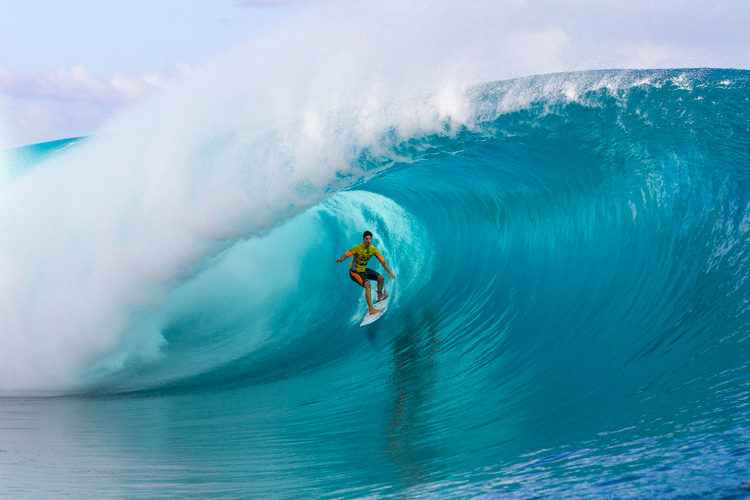
Welcome to "The End of the Road," one of the nicknames for the Paris 2024 Olympic surfing venue, Teahupoo.
Surfing is one of the most spectator-friendly Olympic sports to watch on the television or a computer screen.
After a promising debut in Tokyo 2020, shortboard surfers are set to ignite the warm, transparent Tahitian waters with eye-catching tube-riding skills and spectacular aerial maneuvers.
Here's everything you should know to follow the world's best surfers and one of the planet's biggest and most challenging waves.
The Venue: Tahiti
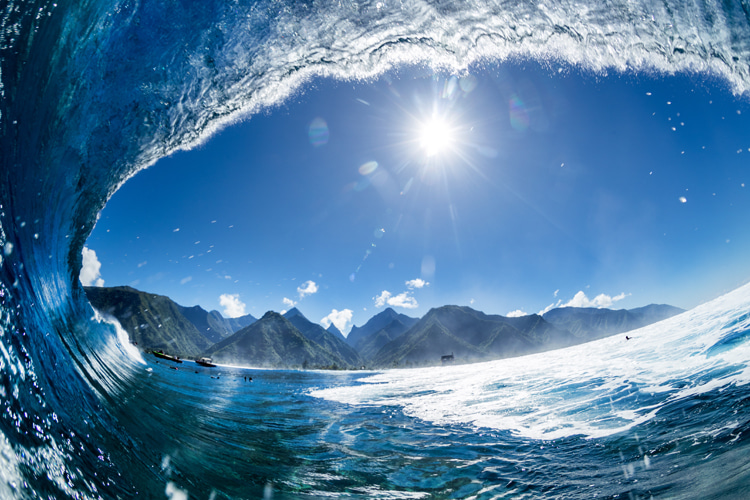
The Paris 2024 Olympic surfing competition will take place in the small village of Teahupo'o, southwest of Tahiti, French Polynesia.
The first person to ride the infamous surf break was Thierry Vernaudon in 1985.
He was followed by two legendary bodyboarders, Mike Stewart and Ben Severson, the first foreign riders to taste this unique and dangerous wave.
The word-of-mouth spread, and this unique tropical surfing paradise soon became one of the most sought-after surf breaks.
Teahupoo, which translates to English as "the pile of heads," "the heap of heads," or "the hot head";
The event window runs from July 27 through August 4, with the following tentative schedule:
- July 27 (1 pm - 10:30 pm): Men's Round 1 (8 Heats) and Women's Round 1 (8 Heats);
- July 28 (1 pm - 10:30 pm): Women's Round 2 (8 Heats) and Men's Round 2 (8 Heats);
- July 29 (1 pm - 10:30 pm): Men's Round 3 (8 Heats) and Women's Round 3 (8 Heats);
- July 30 (1 pm - 10:50 pm): Men's Quarterfinals, Women's Quarterfinals, Men's Semifinals, Women's Semifinals, Men's Bronze Medal Heat, Women's Bronze Medal Heat, Men's Gold Medal Heat, Women's Gold Medal Heat;
NBCUniversal and Peacock will broadcast the Paris 2024 surfing program in the United States. Cj Kirwan will be the network's correspondent at Teahupoo.
Globo (Brazil), BBC (UK), Eurosport, Max and Discovery (Europe), Nine Network (Australia), CBC (Canada), Sky (New Zealand), and many other continental and national TV networks will bring you the live coverage of every wave ridden in Tahiti.
It will be the longest distance between a venue and the host city in the Olympic Games history: 9,755 miles (15,700 kilometers).
Duke Kahanamoku (1890-1968), the father of modern surfing, was the first to campaign for the sport's inclusion in the Olympic program.
Teahupoo will host the second Olympic surfing appearance after Tsurigasaki Beach, Japan, in Tokyo 2020.
There was controversy surrounding the preparations for the 2024 Olympic surfing competition - the judging tower.
A nine-tonne aluminum scaffolding replaced the old wooden structure installed on the reef and used since 2003.
The new judging tower was considered a threat to the local fragile marine ecosystem. During its installation, a barge damaged part of the coral.
Unusual scenes and moments at The End of the Road? Sure - a surfer set on fire and getting barreled and a motorcycle rider taking on a 15-foot wave.
The Wave: Teahupoo
Teahupoo is known in the surfing world for its spectacular left-hand barreling waves, which detonate on a very shallow coral structure, sometimes slightly over a foot (30 centimeters).
The wave breaks around 500 yards off the coastline in a local reef pass.
Surfers should expect heavy, hollow, and fast-breaking waves in the 6-26-foot (1.8-8 meters) range.
Why do waves at Teahupoo get so big?
The deep, heavy liquid gem forms when the sea floor suddenly changes.
Just a little past the shallow reef, the ocean floor drops drastically, going from deep to very shallow in a short distance.
This quick change is why waves build up high over the coral before crashing down with great force.
Because of all the water moving so forcefully, the waves have a thick, heavy lip. The ride itself is relatively short in length, between 75 and 100 yards.
The lip of a wave is the part surfers, and spectators see curling over at the top.
These waves are hard to ride because they're abnormally heavy, especially with the shallow reef below.
The best time of the year to witness epic conditions at Teahupoo is between April and September, especially in the morning, with a SSW swell and NE/ESE winds.
Five surfers have died surfing Tahiti's most powerful wave. Broken vertebrae and scalp wounds are more than common injuries.
One of Teahupoo's most memorable surfing sessions occurred on August 17, 2000, when Laird Hamilton dropped into the so-called Millennium Wave.
The Rules: Format, Judging, and Scoring
Paris 2024 surfers will compete in a ladder tournament-style contest for gold, medal, and bronze medals.
Round 1 features eight heats of three surfers each.
The winner of each heat moves straight to Round 3, while the other two surfers go to Round 2.
Round 2 consists of eight heats of two surfers, with the winner advancing to Round 3 and the loser getting eliminated.
Round 3 has eight single-elimination heats of two surfers, with the winner moving to the quarterfinals and the loser going home.
The four quarterfinal heats repeat the head-to-head clashes, with the winner advancing to the semifinals.
In the two semifinals, the losers compete in the bronze-medal matchup; the winners secure a place in the final.
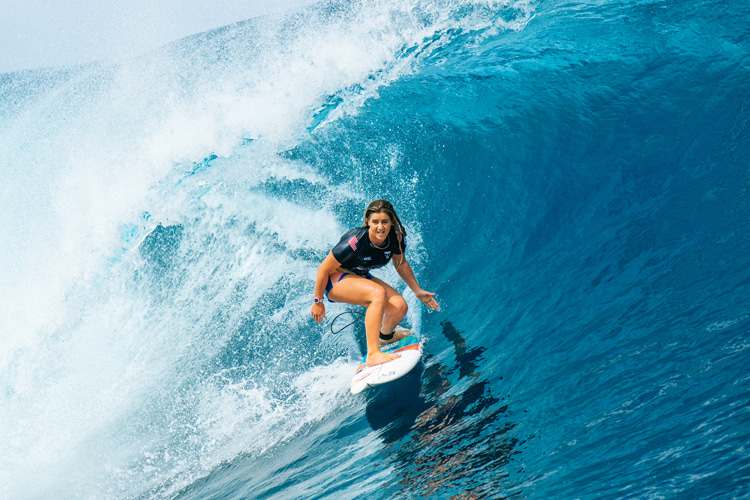
Surfers are scored by a panel of judges on their two best waves on a scale from 0 to 10 and a maximum of 20 points.
The athlete with the highest total score wins the heat.
The duration of each heat depends on the ocean conditions and wave availability/consistency and could be set by organizers in 15-45 minutes.
Judges will mainly be looking for tube-riding skills, i.e., the time spent inside the transparent cylinders, the size of the wave, and the distance traveled in the tube.
The Surfers: Names and Seeding Criteria
Surfing's qualifying period for the Paris 2024 Olympic Games runs from September 2022 to June 2024.
Athletes qualified via:
- 2022 ISA World Surfing Games (WSG);
- 2023 ISA World Surfing Games (WSG);
- Santiago 2023 Pan American Games;
- 2023 WSL Championship Tour (CT);
- 2024 ISA World Surfing Games (WSG);
The program at Teahupoo features 24 male and 24 female athletes. They are:
Men
- Kanoa Igarashi (JPN) | 2023 ISA World Surfing Games
- Jordy Smith (RSA) | 2023 ISA World Surfing Games
- Billy Stairmand (NZL) | 2023 ISA World Surfing Games
- Kauli Vaast (FRA) | 2023 ISA World Surfing Games
- Filipe Toledo (BRA) | 2023 WSL Championship Tour
- Ethan Ewing (AUS) | 2023 WSL Championship Tour
- Griffin Colapinto (USA) | 2023 WSL Championship Tour
- Leonardo Fioravanti (ITA) | 2023 WSL Championship Tour
- John John Florence (USA) | 2023 WSL Championship Tour
- Jack Robinson (AUS) | 2023 WSL Championship Tour
- Matthew McGillivray (RSA) | 2023 WSL Championship Tour
- João Chianca (BRA) | 2023 WSL Championship Tour
- Alan Cleland Jr. (MEX) | 2023 WSL Championship Tour
- Reo Inaba (JPN) | 2023 WSL Championship Tour
- Lucca Mesinas (PER) | 2023 Pan American Games
- Alonso Correa (PER) | 2024 ISA World Surfing Games
- Andy Criere (ESP) | 2024 ISA World Surfing Games
- Joan Duru (FRA) | 2024 ISA World Surfing Games
- Ramzi Boukhiam (MAR) | 2024 ISA World Surfing Games
- Rio Waida (INA) | 2024 ISA World Surfing Games
- Tim Elter (GER) | 2024 ISA World Surfing Games
- Gabriel Medina (BRA) | 2024 ISA World Surfing Games
- Bryan Perez (ESA) | Universality Allocation
Women
- Tatiana Weston-Webb (BRA) | 2023 WSL Championship Tour
- Johanne Defay (FRA) | 2023 WSL Championship Tour
- Brisa Hennessy (CRC) | 2023 WSL Championship Tour
- Teresa Bonvalot (POR) | 2023 WSL Championship Tour
- Sarah Baum (RSA) | 2023 ISA World Surfing Games
- Shino Matsuda (JPN) | 2023 ISA World Surfing Games
- Saffi Vette (NZL) | 2023 ISA World Surfing Games
- Vahine Fierro (FRA) | 2023 ISA World Surfing Games
- Carissa Moore (USA) | 2023 WSL Championship Tour
- Tyler Wright (AUS) | 2023 WSL Championship Tour
- Molly Picklum (AUS) | 2023 WSL Championship Tour
- Caroline Marks (USA) | 2023 WSL Championship Tour
- Sanoa Dempfle-Olin (CAN) | 2023 Pan American Games
- Nadia Erostarbe (ESP) | 2024 ISA World Surfing Games
- Janire Gonzalez-Extabarri (ESP) | 2024 ISA World Surfing Games
- Sol Aguirre (PER) | 2024 ISA World Surfing Games
- Tainá Hinckel (BRA) | 2024 ISA World Surfing Games
- Yolanda Hopkins (POR) | 2024 ISA World Surfing Games
- Anat Lelior (ISR) | 2024 ISA World Surfing Games
- Camilla Kemp (GER) | 2024 ISA World Surfing Games
- Siqi Yang (CHN) | 2024 ISA World Surfing Games
- Caitlin Simmers (USA) | 2024 ISA World Surfing Games
- Candelaria Resano (NCA) | Universality Allocation
The seeding criteria for the heats prioritize the surfers' results and qualifications in the following order:
- 2024 ISA World Surfing Games;
- 2023 World Surf League (WSL) Championship Tour (CT);
- Continental position;
- Team champion at the 2022 WSG;
- Team Champion at the 2024;
- Universality allocation;
Three male world surfing champions will be riding for medals at Teahupoo: Filipe Toledo, John John Florence, and Gabriel Medina.
On the women's side, there are also three world champions: Carissa Moore, Tyler Wright, and Caroline Marks.
Teaupoo is a left-hand wave, meaning that it peels and breaks from the right to the left.
Consequently, in theory, it benefits goofy-footed surfers, that is, athletes who ride with their right foot forward on the surfboard and their chest facing the wave.
Nevertheless, competitively speaking, the odds are relatively even.
Let the Games begin.
Words by Luís MP | Founder of SurferToday.com
por Surf News | Headlines and Top Stories https://ift.tt/V6NLWYB