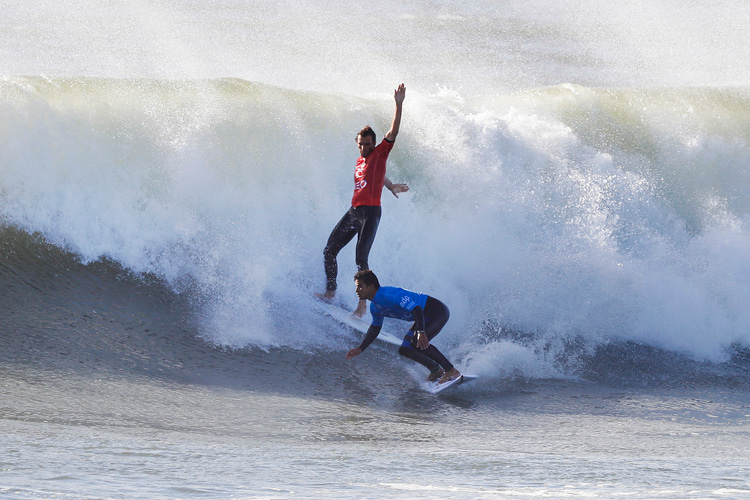
If you exclude the tandem surfing discipline, competitively speaking, surfing is often portrayed as an individual sport.
Also, it's one of those sports in which you rely more on what you do than on what your opponent is doing.
Surfers competing in a contest are supposed to perform well enough in front of a judging panel to earn high scores and progress through the ladder tournament-style event format.
You expect a surfer wearing a jersey to focus on what they can do on a wave better than anyone else, particularly their heat opponents.
So, surfing is unlike tennis, judo, boxing, or even chess, in which individuals interact directly with their opponents to try and win a game or a combat.
However, in competitive surfing, doing your best to win does not mean you don't have to worry about your opponent.
Not only you do, but you should.
In other words, surfers can prevent their opponents from taking the best waves in order to block their chances of maximizing their scoring potential.
That's when we enter the sport's tactical and strategy component that often decides heat wins, event trophies, and world titles.
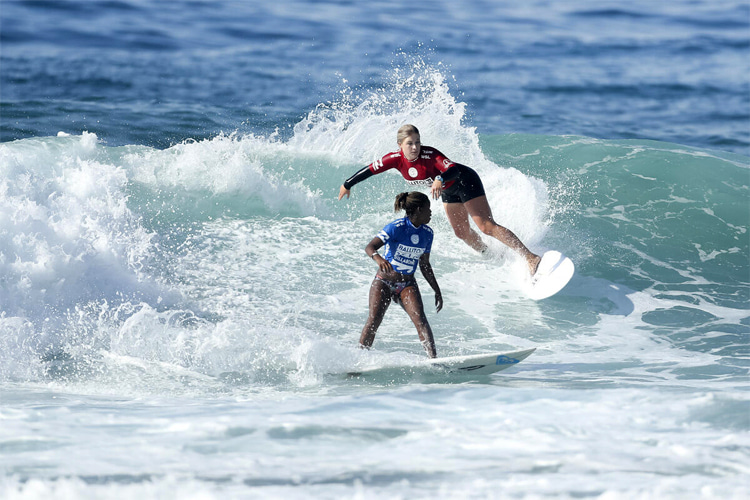
Surfing With or Against?
Competitive surfing is about skills, tactics, and having a plan for the person, sportspeople, and ocean conditions you face.
Shooting is an individual Olympic sport.
However, despite competing against fellow shooters, the athlete focuses solely on his target and can do nothing to affect the adversaries.
In surfing, when you're watching a contest, there's more than meets the eye.
An athlete can actually hinder someone's two-wave total, knowing that penalties like loss of priority and one of their two scores halved/zeroed will apply.
It's called interference. The rules differ depending on whether it's a World Surf League (WSL) or International Surfing Association (ISA) event.
So how could an interference be sufficiently appealing or worth it for surfers to actually think it's the best possible option at a given moment?
Intentional interferences are relatively rare in competitive surfing, but they've occurred with impactful consequences.
The goal is always clear: hinder someone's scoring potential on a wave.
In the vast majority of situations, "crime" doesn't pay. But when it does, it can, for instance, change a career.
The Juniors Case Study
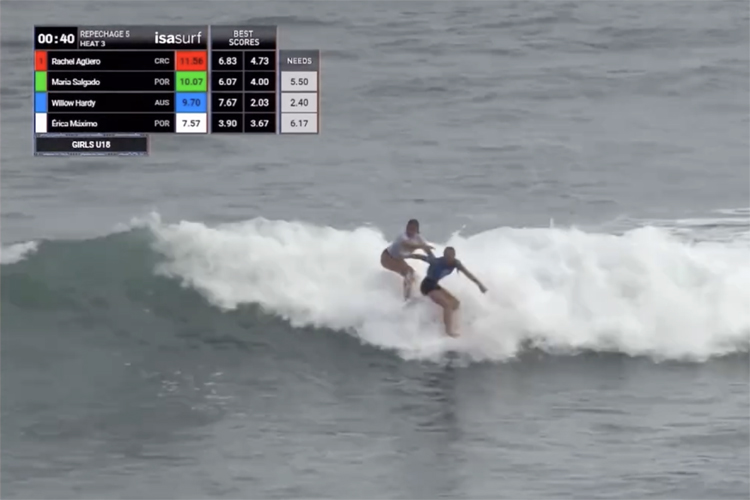
The 2024 ISA World Junior Championship had an unusual incident that unfolded in heat 3 of the repechage Round 5.
Four surfers were in the water: Rachel Agüero from Costa Rica, Willoy Hardy from Australia, and Maria Salgado and Erica Maximo from Portugal.
With 50 seconds remaining on the clock, Agüero was first, Salgado was second, Máximo was third, and Hardy was fourth.
Despite being in the last place, the Australian only needed a 2.4 score to get second and progress.
Both the Australian and Portuguese surfers positioned themselves on the inside. A good wave approached.
Seizing the opportunity, Hardy caught it in the final seconds.
However, the Portuguese competitor in the white jersey attempted to impede the Australian's progress.
According to the Irukandjis, the Australian Surfing Team, Máximo attempted to push Hardy off her board and yelled verbal abuse before trying to grab Hardy's leash.
Despite Máximo's surprisingly aggressive tactics, the Australian was able to complete the ride and earned the score she needed to advance to the next stage.
The unsporting conduct shocked organizers, athletes, fans, and even the athlete's team and national surfing federation.
There's more to Maximo's behavior than the raw brutality of the images.
She wanted to help her teammate - and ultimately her country - to move through to the next stage by sacrificing her heat and her reputation.
Although an unacceptable, unsporting behavior, it certainly was a momentary loss of an acceptable tactical compass.
When Surfing Becomes a Team Sport
In rugby, several obstruction laws regulate what players can and cannot do.
For instance, they can tackle a player possessing the ball but cannot deliberately impede or obstruct opponents from pursuing it.
The ISA World Surfing Games and the ISA World Junior Championship introduce the team element to competitive surfing.
There's the team world champions title and the Aloha Cup winners.
Simultaneously, surfers compete individually with a strong sense of nationality and belonging to a team backing them up and waving flags on the beach.
The decision to protect, defend, or support - whatever you want to call it - a fellow countryperson is almost instinctive and second nature.
All within fair sense boundaries, obviously.
The young Portuguese surfer quickly realized she had made a mistake and issued a public and honest apology in a video punctuated by heartfelt tears.
Máximo will surely have plenty of opportunities to unveil all her surfing and sportsmanship.
Everybody makes mistakes, and we have all done (or thought) worse throughout our lives.
The only reflection the incident brought to the surface is the role of tactics and strategy in surfing as a sometimes near-team sport.
The dilemma is present, for instance, in Formula 1.
Should a Ferrari F1 driver let his teammate overtake him because he needs more points than the sacrificed driver?
What is the role and weight of the individual in a two-person team?
And what is the impact of the national flag in assessing real-time ethical-based decisions?
Can all winning rules be poured into a sport's rulebook? What is my and your gray area?
Words by Luís MP | Founder of SurferToday.com
por Surf News | Headlines and Top Stories https://ift.tt/U21f85a