Pular para o conteúdo principal

SurfTown MUC wave pool powered by Endless Surf ignites Munich

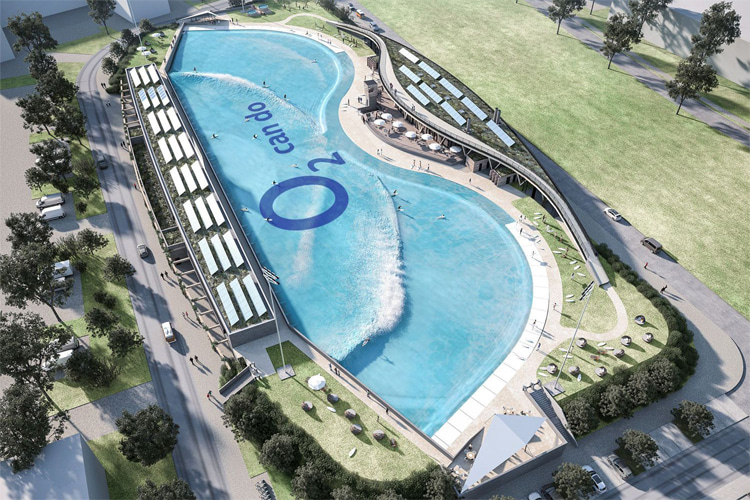
O2 SurfTown MUC: Europe's largest wave pool is 50 percent bigger than a football pitch | Photo: SurfTown MUC

The waves at O2 SurfTown MUC are rolling. Europe's largest wave pool opens in Summer 2024 in Munich, Germany.

The basin has been filled with water, and the 34 pneumatic chamber machines have produced the first artificial waves.

Endless Surf, a wave generation technology powered by WhiteWater, is making its grand debut with a stadium-sized surf lagoon in the capital of Bavaria.

SurfTown MUC is a 180-meter-long wave pool featuring four different surf zones, each allowing a maximum of 16 surfers simultaneously.

It's over 50 percent longer in length than a football pitch.

The one-hour sessions guarantee a minimum of 12 wave ride attempts per surfer.

The Munich wave pool will be open seven days a week, all year round.

During summer, it opens at 7 am and closes at 10 pm. In winter, only extreme weather conditions may force closures.

The non-heated water temperature will be around 24 °C (75 °F) in the warm season and potentially below 10 °C (50 °F) in wintertime.

Up to 2.1-meter Waves

There are seven different wave heights for seven different experience levels. They are:

  • First-timer: 0.5 meters;
  • Rookie: 0.7 meters;
  • Progressive: 1.0 meters;
  • Intermediate: 1.4 meters;
  • Advanced: 1.7 meters;
  • Expert: 1.9 meters;
  • Pro: 2.1 meters;

Surfers choosing levels from First-timer to Advanced will be coached and/or guided by staff into the human-made wave.

They will provide safety, support, and technical guidance.

Whenever a surfer completes a ride, they have two ways to return to the central lineup, both of which are located on the outer limits of the wave pool.

The technology developed by Endless Surf generates all the types of waves found in the ocean, the natural environment.

There are barrels, air sections, mellow longboarding ripples, two point breaks, and a challenging A-frame peak.

The left and right point breaks create an 18-second long wave that peels across the entire wave pool length, with multiple workable sections.

The A-frame zone features a central peak that allows surfers to go left or right in waves running along the generator.

There are also two warm-up areas where surfers can prepare, stretch, gear up, and have safety briefings.
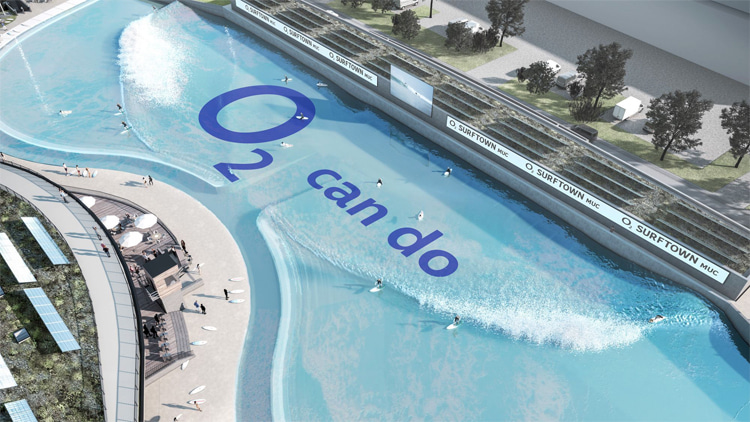
O2 SurfTown MUC: the wave pool features four different surf zones, each allowing a maximum of 16 surfers simultaneously | Photo: SurfTown MUC

Sustainable From Birth to Operation

Sustainability was and is at the core of SurfTown MUC operation.

The mega-structure was built near good, existing public transport connections in a non-conservation area.

The wave pool is connected to a photovoltaic park and uses stored energy at night and on days of little sun exposure.

The planned degree of self-sufficiency is a minimum of 80 percent.

The closed-water system uses less chlorine than standard swimming pools, and the cooling and heating of the main building uses geothermal energy.

The maintenance of the lagoon's water does not require emptying and refilling, and the wave generation is adapted to the real-time usage and capacity.

The presale 10, 25, and 50 surf session packages sold out, with prices of €749, €1,699, and €2,899, respectively.

The single, presale A-frame surf session costs €79.


Words by Luís MP | Founder of SurferToday.com


por Surf News | Headlines and Top Stories https://ift.tt/sdn6SjX

Postagens mais visitadas deste blog

Duke Kahanamoku reflects on surfing, Olympics, and old Hawaii in 1966 interview

Duke Kahanamoku is the most influential surfer of all time and is often hailed as the father of modern surfing. There is nearly no one questioning these titles. Recently, Public Broadcasting Service (PBS) Hawaii unveiled a never-before-seen interview with the legendary surfer and Olympic swimmer. In the 1966 episode of Pau Hana Years, a seminal Hawaii television program that aired on KHET-TV (now PBS Hawaii) for 16 years, running from 1966 until 1982, Bob Barker chats with Duke Kahanamoku, then 76. The conversation drifts from royal ancestry to Olympic lanes, from Hollywood sets to a surfboard shaped by hand, tracing the outline of a life that helped define modern surfing and Hawaii's public image in the 20th century. And if you know little about the man who dreamed of getting surfing into the Olympic Games, this is a precious piece of history. A name with history, worn casually The interview starts with Kahanamoku explaining that "Duke" is not a title but his giv...

The hydrodynamics of surfboard fins

Have you ever wondered why a surfboard fin looks like that? It is a single or a set of fixed blades or keels located under a board, near the tail, often no bigger than a hand. Yet that small surface is where much of the surfboard's behavior takes place. Speed, hold, looseness, and the feeling of control all trace back to how water moves around fins. The physics of surfboard fins falls under hydrodynamics, the study of how fluids behave in motion. So, according to science, they feature a shape designed to turn flowing water into several forces. Let's take a look at what's at stake when fins and water interact. Lift and the feeling of control One of the key variables in hydrodynamic terms involving surfboard fins is lift. When a surfer leans into a turn, the board tilts and the fins meet the water at an angle. The angle is enough to create a pressure difference between the two sides of the fin. Water speeds up on one side and slows on the other. The result is a sidewa...

How paddleboarding transforms your body and mind

Adventure is on our doorstep. With so many different bodies of water available to paddleboarders, from city canals to coastal routes, we can find adventure in places much closer to home than people might initially expect. According to the Canal and River Trust, 50 percent of people in England and Wales live within just eight kilometers of a canal or river, and eight million people live less than one kilometer away. I had lived within just a few kilometers of the Leeds and Liverpool Canal for years and never really explored it before stand-up paddleboarding (SUP) came into my life . The challenge created both a new perspective and a deeper love for where I lived and the areas which I passed through. On my coast-to-coast journey, I slept in my own bed for two nights as the route passed through my then hometown of Skipton, yet I felt I was on a grand journey of discovery. We are braver, stronger, and more resilient than we think. SUP not only helps us feel more connected to our va...