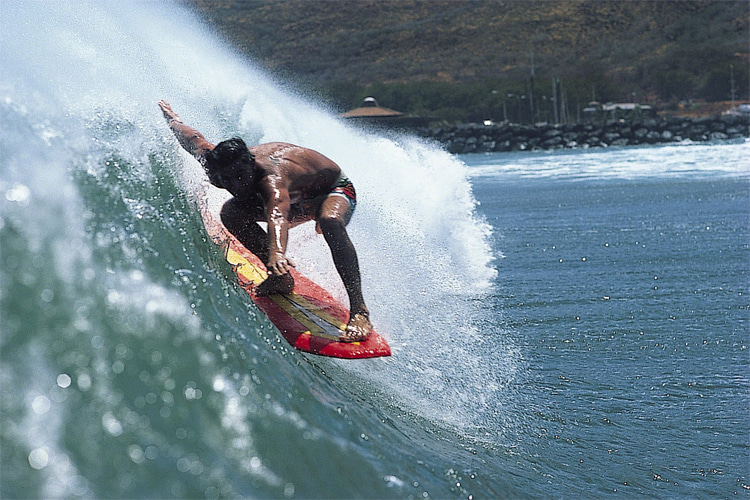
Imagine a wave that behaves like a super-fast cargo train, rushing to reach its destiny at incredible speed. This wave is real. It's called Maalaea.
There are few places in the world where the number of surfers in the water on a given day surpasses the local population.
The census-designated place (CDP) of Mā'alaea in Maui is home to just around 310 people, but its waters can get crowded when south swells hit its beachless shoreline.
Welcome to Maalaea Freight Trains, the nickname for what many believe to be the world's fastest, makeable surfing wave.
The bold claim has solid structures, though.
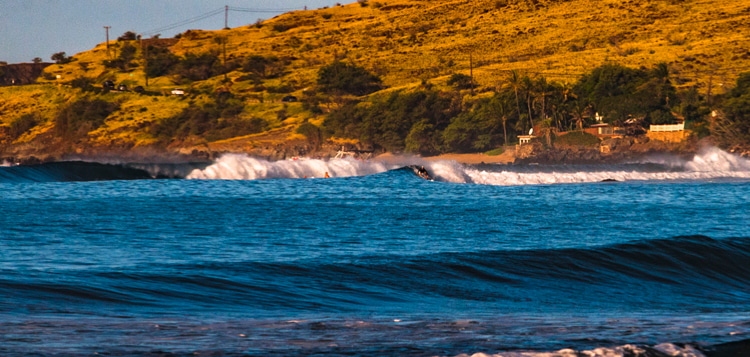
The legendary surf spot is located in Ma'alaea Bay, on the west coast of Maui, east of Ma'alaea Harbor, in front of a series of condos and resort hotels.
Who would've thought that a world-class right-hand reef break could pop up in a place where you cannot even lay a beach towel?
The secret lies in the stone wall of the harbor that grooms this unlikely wave.
Maui's F1 Surfing Wave
The wave has many names. In the surfing world, it is known as Maalaea, Freight Trains, or Ma'alaea Pipeline.
In the years preceding World War II, Mā'alaea Bay attracted longboard surfers with its infectious waves.
Its central star, Freight Trains, was immediately hailed as one of the fastest rideable waves globally, contingent upon specific conditions for its occurrence.
In the late 1960s, the Valley Isle gained notoriety as a psychedelic hotspot influenced by LSD, an aspect of its culture famously showcased in the Jimi Hendrix concert film "Rainbow Bridge."
The movie, predominantly shot in Haleakalā Crater, also featured surfing clips from Maalaea and was completed just three months before Hendrix's death.
According to surf historian Matt Warshaw, author of "The Encyclopedia of Surfing," "local surfer Joseph 'Buddy Boy' Kaohi was so highly regarded at Maalaea in the late 1960s and early 1970s that the break was sometimes referred to as 'Buddy's Bay.'"
But it was only with the shortboard revolution that the world's fastest right-hander became fully rideable.
Other standout Maalaea riders include Maui residents Analu DePonte, Brad Lewis, Chris Lassen, Chris Vandervoort, Eli Hanneman, Eric Totah, Ian Gentil, Ian Walsh, Imaikalani DeVault, Jackson Bunch Kai Lenny, Kelson Lau, Kevin Sullivan, Lloyd Ishmine, Mark Anderson, Sai Smiley, Tanner Hendrickson, Tom Dosland, Ty Simpson-Kane, Tyler Larronde, and many others.
The break's local bathymetry plays a critical role in the temperamental and machine-like wave's anatomy.
The seabed is made of sharp coral and lava rock, angled at just the right degree, producing the barreling bullet train we occasionally see on videos.
When the surf gets above six feet (1.82 meters), you'll need a lot of self-confidence and experience to handle the tricky and steep take-off.
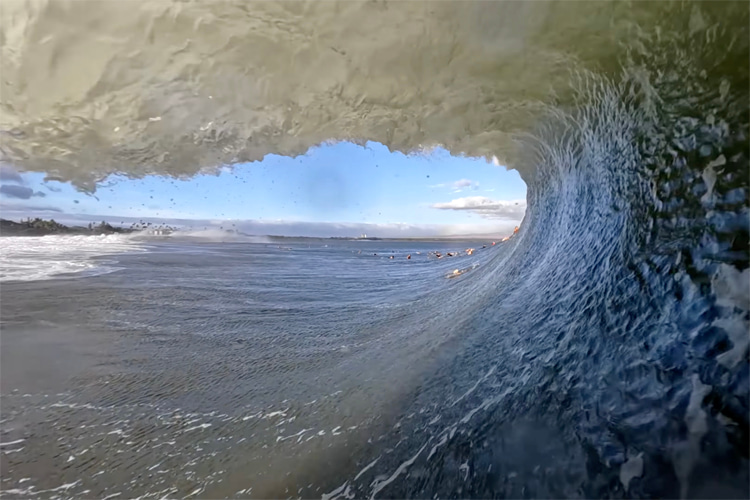
However, once you drop in, you're sucked into a speedy Formula 1 racetrack that reminds us of Banzai Pipeline but in reverse. Or a blend of Nias and Skeleton Bay.
The right-hand tube ride's length ranges between 150 and 300-plus yards. Not bad, right?
Fickle and Rare
The wave features five sections:
- Off the Wall;
- Impossibles;
- Freight Trains;
- Down the Line;
- Inside Section;
Maalaea Freight Train requires a 3-to-5-foot swell to get things started, ideally on low tide.
Nevertheless, it only reaches firing status with 12-foot-plus waves courtesy of purple-to-black S-SW swells lined up perfectly with an eight-mile-wide gap between the island of Kahoolawe and the southwest tip of Maui and SE winds.
Do not expect this Maui gem to trigger historical sessions every week. Due to its picky requirement, Maalaea only shines in all its glory a handful of times a year.
And that probably explains why no contests have ever been held at this magical surfing arena.
On epic days, the word will spread quickly, meaning the lineup and the take-off zone tickets for this liquid TGV sell fast.
In the 21st century, Maui's Freight Trains delivered superb conditions on two occasions, only - 2005 and 2022.
Maalaea is a fickle, advanced, and expert-only wave. Beware of the shallow reef, rip currents, and uber-hollow waves.
In addition, make sure to make a wise wave selection, as a set could pump over 15 nonstop waves, and getting caught inside might result in a multiple-wave hold-down.
The chances of someone dropping in as a falling lip is about to engulf your F1 car are also high.
The truth is that many get covered, but only a few find the exit. Some actually state that only one-fourth of the waves are completed.
Equipment choice is critical.
You'll need a surfboard that can enter the wave as quickly as possible and doesn't pick up the 20-30 knots offshore wind that often blows strong.
Spring and summer are the best times of the year to get the session of your life at Maalaea Freight Trains.
If it isn't pumping, there will always be Honolua Bay and Jaws/Peahi.
Forever Protected
From time to time, developers have proposed enlarging Maalaea Harbor, which was constructed in 1952.
It was widely believed that any expansion would inevitably jeopardize or destroy the quality of the surf in the area.
In 2002, "Maalaea: A Cry for Help," a documentary highlighting the ongoing conflicts between developers and the Maalaea break, was released.
The good news is that in 2012, after 23 years of intense activism, the iconic Maui wave was preserved.
The victory was declared following the Hawaii Department of Land and Natural Resources and the United States Army Corps of Engineers' decision to abandon plans to extend the harbor's breakwater.
Groups like the Surfrider Foundation have vehemently opposed the project, fearing significant damage to coral reefs and the cherished surf spot.
Authorities cited concerns over high costs, community sentiment, and environmental impacts for suspending the breakwater project.
Watch Maalaea's stunning Freight Trains at their best in the surf movies "Angry Sea" (1963), "Adventures in Paradise" (1982), "Amazing Surf Stories "(1986), and "Maui '99" (2000).
Words by Luís MP | Founder of SurferToday.com
por Surf News | Headlines and Top Stories https://ift.tt/7Hjhgn2