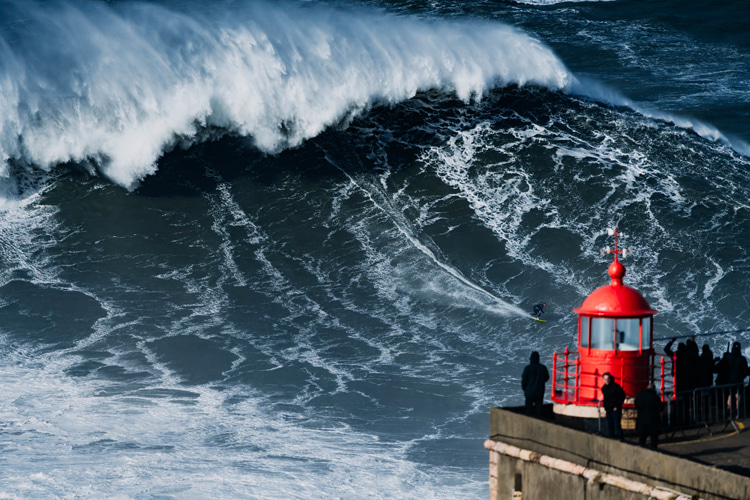
Big wave surfing is an industry with an industry.
The relentless chase for world records translates into prize money and sponsorship deals.
Athletes have been pushing their limits and putting their lives on the line to ride bigger and heavier waves.
Top athletes now work with multidisciplinary teams involving personal trainers, psychologists, nutritionists, photo and videographers, and public relations professionals.
This 360-degree approach brings world-renowned big riders closer to their goal of holding the record for the largest wave ever surfed.
Sebastian Steudtner is one of them.
The German holds the coveted Guinness World Record trophy validated by the World Surf League.
But the 2023/2024 winter season was particularly rich in XXL swells and potentially world record-breaking feats.
Drones to Measure Wave Height
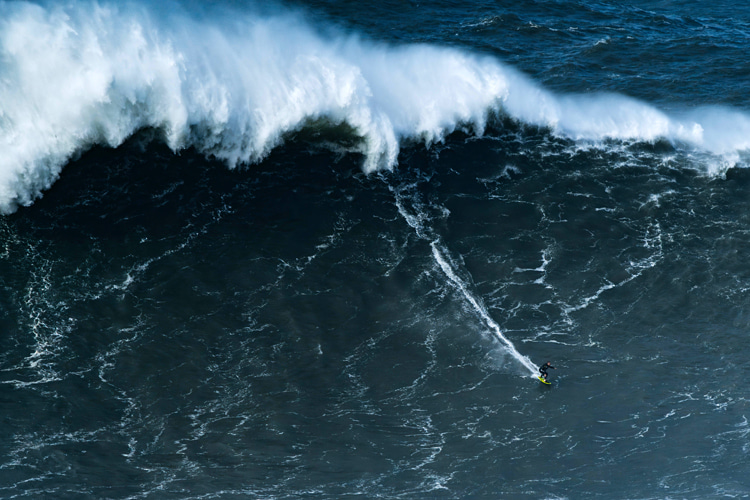
So, because the best defense is the attack, Steudtner leveraged "state-of-the-art drone technology" developed by Porsche Engineering to measure one of his best recent rides at Nazaré.
The drone prototype from the joint technology project between Team Steudtner and Porsche Engineering was used during this winter's XXL swell.
According to the German team, the device determines the height of waves quickly and precisely.
The prototype is equipped with cameras, control units, and storage devices.
In addition, sensors are used in vehicle development to support modern driver assistance systems.
The drone can measure all areas of the wave and the surfer within a radius of about 100 meters.
"We are very pleased to have created an innovative solution that can advance the sport of surfing," says Marcus Schmelz, Project Manager at Porsche Engineering.
"It was a challenge to develop a drone that can measure not only the height of the waves but is also capable of tracking the surfer within the radius throughout the entire wave ride."
Porsche Engineering's drone measured Sebastian's wave at Nazaré at 93.73 feet (28.57 meters). The wave was caught and ridden on February 24, 2024.
The current world record, also held by Steudtner, is 86.4 feet (26.21 meters), which was achieved at Nazaré in 2020.
The current official WSL measurement model uses video footage and still images to determine wave height.
"We are open to sharing our technical insights from the drone development with official experts," adds Schmelz.
"Our goal is to further increase transparency in big wave surfing and to provide accurate measurement data more quickly."
Porsche's drone is not the first to fly over waves and measure them.
In 2020, Teddy Allen and Milan Curcic created Henet Wave, a similar, portable unmanned aerial vehicle (UAV) that works as an aerial surf buoy.
The device was tested in 2022 and has been continuously updated.
Mission Wave Alpha
Sebastian Steudtner's entourage is one of the strongest in the field.
The German is backed up by several multinational corporations, including Porsche, Porsche Engineering, Schaeffler, O2 Germany, Deutsche Vermögensberatung, X-BIONIC, and others.
He recently set up Mission Wave Alpha, a project that aims to get Steudtner surfing waves twice the size of the current world record, i.e., 130-160 feet (40-50 meters).
These brands are helping him push the sport to the next level on all fronts, from water safety to board materials and design.
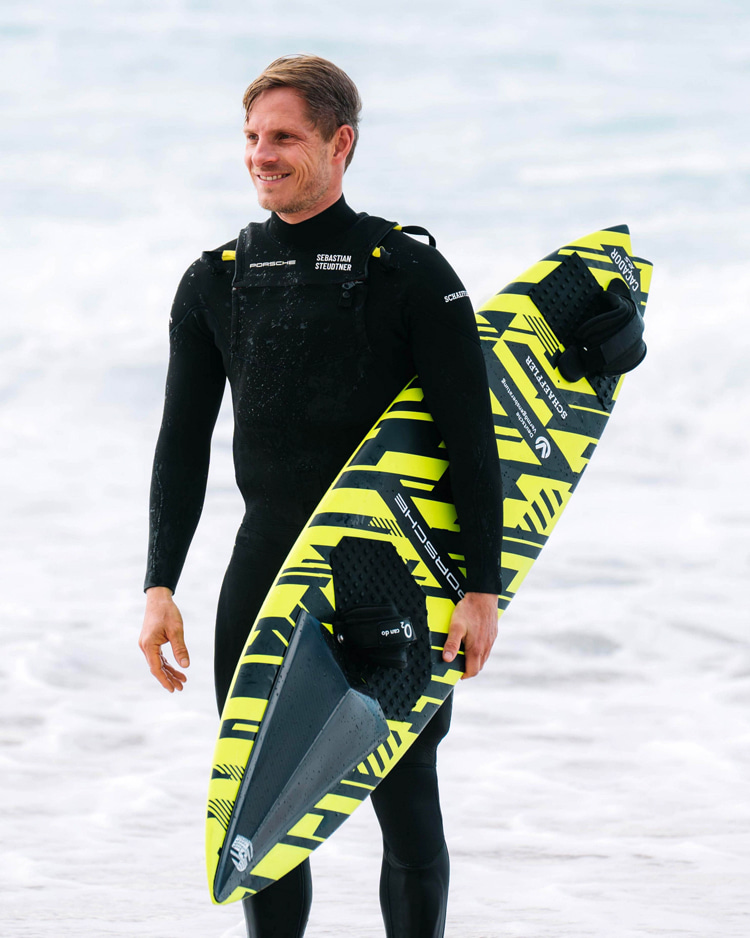
Over the past three years, Steudtner, in partnership with Porsche Engineering and Schaeffler, has developed and optimized new surfboard technology to get him surfing the biggest waves possible.
For instance, to reduce water and air resistance, a fundamental variable in surfing, the surfer and his tech team used the latest simulation methods and wind tunnel validations.
As a result, with the new board "Caçador RS," Steudtner says he can now reach speeds of up to 100 kilometers per hour, compared to the previous 80 kilometers per hour.
Higher speed is critical to riding larger waves because the taller a wave is, the faster the surfer must be so that it doesn't overrun him.
Now, this speed advantage enabled Steudtner to ride the potential next record wave.
"I am very proud to be able to bring big wave surfing to the next level through the development of safety and technology and by believing in my dream," concludes Sebastian Steudtner.
"Together with my team, which is driven by its unique 'can do' mindset to define possible in big-wave surfing, we were able to accomplish this mission."
The race for the world's largest wave ever surfed is on, with Lucas "Chumbo" Chianca also claiming a potential record in Praia do Norte, Nazaré, Portugal.
Words by Luís MP | Founder of SurferToday.com
por Surf News | Headlines and Top Stories https://ift.tt/nUKxRiF