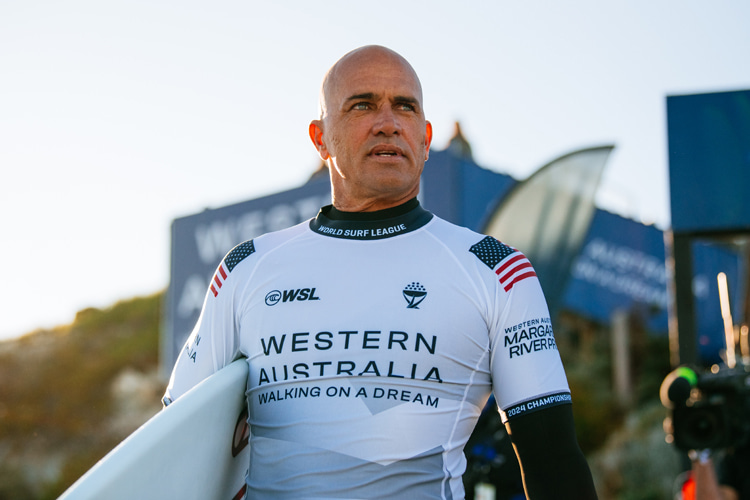
The most successful competitive surfer of all time, Kelly Slater, rode what may have been the last heat of his 24-year professional career.
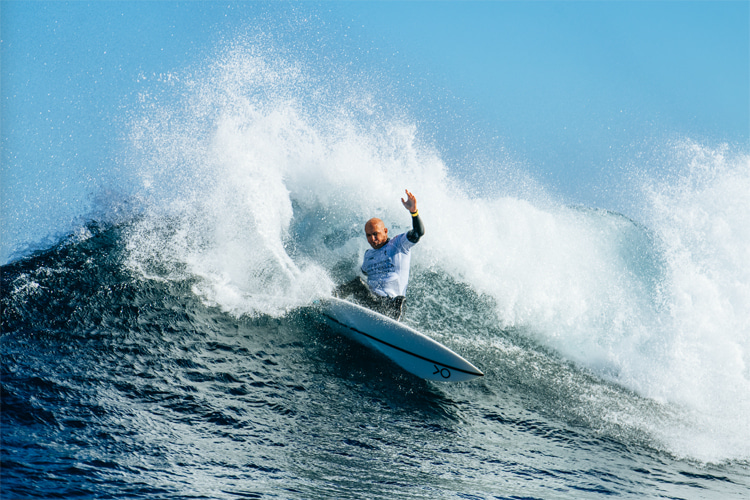
The 11-time world surfing champion survived the elimination round at Margaret River but lost his Round 32 against Griffin Colapinto.
Consequently, Slater does not make the mid-season cut and is expected to hang his leash when it comes to professional surfing.
There was never a formal announcement, but it's clear from his emotional post-comp words that surfing's greatest of all time (GOAT) is moving on to a new stage of his life.
It's been 44 years of putting on a jersey and lifting trophies since the Cocoa Beach-born started competing at eight.
The youngest (20) and the oldest (39) surfer to conquer a world surfing title won 56 Championship Tour (CT) events.
The first contest win arrived in 1992 at Rip Curl Pro Landes, and the last was the 2022 Billabong Pro Pipeline.
Kelly Slater won eight Pipe Masters, three Triple Crown of Surfing trophies, and two Eddie Invitational contests.
In the future, we may see the smooth Floridian taking on his favorite waves as a wildcard: Pipeline, Teahupoo, and Cloudbreak.
What has he missed? The Olympic Games.
In His Own Words
"A lot of emotions today. I look back at my friends who've retired and maybe they can relate to how I'm feeling now - just some relief, you know?"
"There's no sleepless nights with the pressure. I think I put a lot of pressure on myself still to this day."
"For heats, I have a certain expectation for myself, and I haven't been putting in the working discipline, the hours in the water, you got to surf with lots of people and really figure out your boards in the wave and all that stuff and I just did it for so long it's nice to have that rear view at this point."
"I was trying to get myself into the Olympics, and since it doesn't look like at all happening in any reasonable sense, like about 10 people would have to get injured, if a couple of opportunities arise, I'll see how I'm feeling.
"This morning, I fought for the position with Cole and Yago, and it paid off. I started out that heat out really strong, and then I actually wasted priority in a couple of waves that were low-scoring and didn't pan out to be good waves."
"Competitively, I was good in that heat. The heat with Griff, I just got kind of caught in a hole cuz the ocean did die, and the wind came up. I was imagining a seven or eight was going to come when the best wave was going to be that six the Griff got, and I let him have it.
"So, little mistakes there, but you can't predict what ocean's going to do. You go to be in that moment and have an idea of what's going to come."
"But I've been competing for 44 years. I started competing at eight years old in 1980, so I'm used to being in that environment."
"At the same time, I hold myself to a certain standard in my head, so when I'm not getting the results, and I'm not putting myself in competitive situations... you make your own luck."
"I've had a little bit of reluctance. I am surfing very injured still. I probably came back a little too quick after surgery, but you know I wasn't going to stick around till next year and say, 'Can I have one of those wildcards?, especially with João and a couple of guys hurt and they're at the beginning of their career. They have all the desire to be there, and the baby is coming; it's the right time."
"Surfing is number one to me still, and I want to surf my best every day. I still want to get my favorite board and surf my best wave of my life and you know that I don't think that ever goes away."
"It's a funny thing because when I got on Tour, I think Tom Carroll and those guys were about the oldest guys - 29, 30 - and that seemed to be what was going to be ancient surfing."
"So I had this idea that I was going to have a 10-year-long pro career once I got on tour.
"And then I got really burned out at 26 and retired and then three years off, came back, and to be honest, I wasn't really spoken about as being in that picture that first year back. It was Taj, Andy, Parko, Dingo, and that kind of little fire under me for sure."
"I was the underdog because Andy was just on fire those three years. I think he won the first year I was back in the tour - 2002 - and he kind of started his reign."
"And that got me fired up, and then losing so closely to him was really like a heartache for me. You might see it in 'Blue Horizon' - it was tough."
"And then next year, I didn't even try. My heart wasn't in it - I was like, 'That hurts too much to lose that close,' and then in the beginning of 2005, I said to Parko, 'Which one of us is going to take this thing? Come on, let's go!' And then Mick got in the mix. He won in 2007, and then we went back and forth."
"It definitely lit a flame under me, and I felt like that really gave me a lot of longevity because I knew I could dig it out of myself."
This article is being updated.
por Surf News | Headlines and Top Stories https://ift.tt/lD3Z9CW