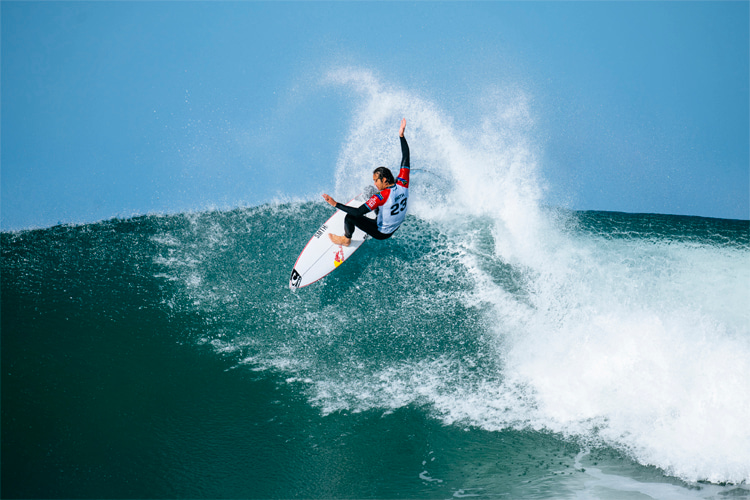
We can't choose our height, and 80 percent of it is genetic. But if you're into surfing, taller and shorter surfers feel noticeable differences in getting acquainted with boards, paddling for, and riding a wave.
In sports, height matters. For the good and the bad.
While shorter athletes tend to perform better in gymnastics and horse riding, taller athletes have the upper hand in basketball and tennis.
At the same time, a surfer's height and weight play a relevant role in learning and evolving their surfing skills.
You don't necessarily need to meet a specific body measurement to be good at surfing, but being fit and staying in shape will always help.
That's the rule number one.
There is also the body type analysis. We all fit in an interval between the three major body types: ectomorph, endomorph, and mesomorph.
In theory, the mesomorph body type would be the ideal pick, but that doesn't exclude everyone else from excelling in surfing.
The Center of Gravity
The history of professional competitive surfing is not statistically clear on whether shorter or taller surfers prevail and win world titles.
According to data, the average-height athlete around 5'7''-5'9" (1.70-1.75 meters) is more successful.
So, how do the body measurement variables get into play when we surf?
In short, the secret lies in the optimal balance between the surfer's weight and height, and surfboard dimensions.
The taller and heavier the surfer, the more volume will be needed in the surfboard; the shorter and lighter the surfer, the less volume will be required in the surfboard.
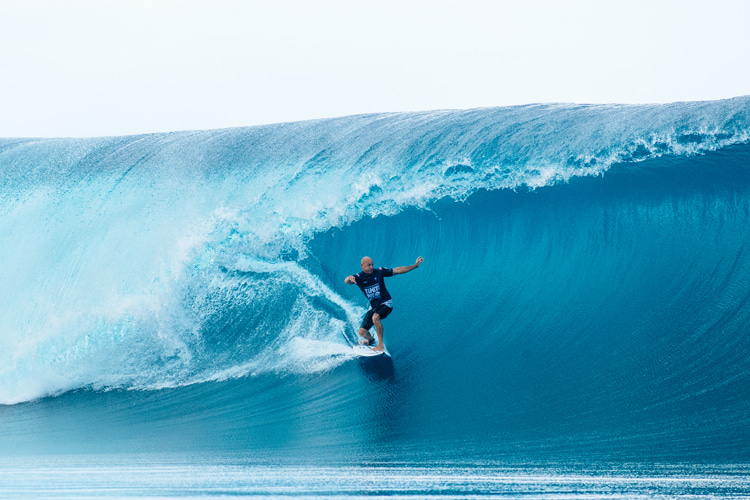
Riding a surfboard demands keeping a low center of gravity, i.e., a low point where the body mass is concentrated, usually about an inch below the navel.
In other words, compressing your knees and legs and staying long is necessary to counterbalance opposing upward and side forces involved in wave riding.
Taller surfers have a higher center of gravity; shorter surfers have a lower center of gravity.
As a result, taller surfers will need to keep their bodies really low to achieve the same riding performances shorter surfers will get in identical wave conditions.
Getting a really tall surfer low on a surfboard comes with several disadvantages, as it will be harder for them to react and adjust to the continuous flow and changes of the wave.
Simultaneously, they will struggle to maneuver the surfboard and perform tricks on the open face and in the air, generate speed, and fit their bodies in tight spaces while doing turns.
The only compensation taller surfers can get is by leveling the size of their surfboards up - in height, width, and overall volume.
The problem is that these changes may not fit and adapt well to, for instance, small wave conditions or less hollow and cylindrical barrels.
Being closer to the surface of the water reduces the chances of falling and vice-versa.
Also, even a taller surfer that is perfectly fit and in shape will weigh more and thus will have more body mass, so they will need larger waves to perform at the highest level.
For taking off, it's also harder for tall surfers.
Due to their longer legs, there's more work to do to bring them up compared to a shorter wave rider.
A larger body is also more prone to injuries. In a wipeout, longer limbs mean more distance to the water.
Advantages of Tall Surfers
It's not only bad news for the tall surfing community.
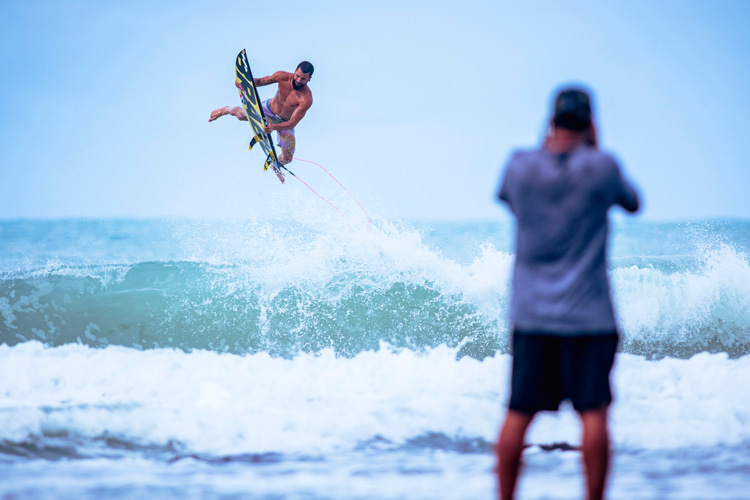
Six-foot-plus male and female wave riders have a few advantages that they can use to enhance their surfing.
Power is the most relevant asset they might possess.
A taller surfer is able to unleash more power in pivoting turns, carves, and top-to-bottom maneuvers than a shorter surfer.
Consequently, they can generate more spray and displace more water than anyone else in the game.
The second advantage is paddling power.
Having longer arms is surely a privilege that could be translated into profit by catching more and better waves or waves that are hard to get into.
One of the helpful tricks for tall surfers is to get bigger than average boards and work on fine-tuning foot positioning.
It is easier to adjust to the ideal placement of the back and front feet on a surfboard with more volume.
Pro Surfers Height
As we've seen above, there is not a fundamental and absolute correlation between height and world champion titles.
However, it is also true that average-height surfers seem to collect more trophies.
Most professional surfers competing on the Championship Tour (CT) are not particularly tall.
In the 2024 season, the median height is 5 ft 11 in (1.80 meters), and the average height is approximately 5 ft 10.74 in (1.79 meters).
Here are their heights sorted from tallest to shortest:
- Jordy Smith: 6 ft, 3 in (1.90 meters)
- Kade Matson: 6 ft, 3 in (1.90 meters)
- Cole Houshmand: 6 ft, 3 in (1.90 meters)
- John John Florence: 6 ft, 2 in (1.87 meters)
- Connor O'Leary: 6 ft, 1 in (1.85 meters)
- Frederico Morais: 6 ft, 1 in (1.85 meters)
- Ian Gentil: 6 ft, 1 in (1.85 meters)
- Ramzi Boukhiam: 6 ft, 1 in (1.85 meters)
- Ryan Callinan: 6 ft, 1 in (1.85 meters)
- Yago Dora: 6 ft, 0 in (1.82 meters)
- Jake Marshall: 6 ft, 0 in (1.82 meters)
- Griffin Colapinto: 5 ft, 11 in (1.80 meters)
- Gabriel Medina: 5 ft, 11 in (1.80 meters)
- Ethan Ewing: 5 ft, 11 in (1.80 meters)
- Jack Robinson: 5 ft, 11 in (1.80 meters)
- Crosby Colapinto: 5 ft, 11 in (1.80 meters)
- Kanoa Igarashi: 5 ft, 11 in (1.80 meters)
- Callum Robson: 5 ft, 11 in (1.80 meters)
- Eli Hanneman: 5 ft, 11 in (1.80 meters)
- Leonardo Fioravanti: 5 ft, 11 in (1.80 meters)
- Liam O'Brien: 5 ft, 11 in (1.80 meters)
- Matthew McGillivray: 5 ft, 11 in (1.80 meters)
- Jacob Willcox: 5 ft, 11 in (1.80 meters)
- João Chianca: 5 ft, 11 in (1.80 meters)
- Kelly Slater: 5 ft, 9 in (1.75 meters)
- Samuel Pupo: 5 ft, 9 in (1.75 meters)
- Barron Mamiya: 5 ft, 9 in (1.75 meters)
- Filipe Toledo: 5 ft, 9 in (1.75 meters)
- Miguel Pupo: 5 ft, 9 in (1.75 meters)
- Deivid Silva: 5 ft, 7 in (1.70 meters)
- Imaikalani deVault: 5 ft, 7 in (1.70 meters)
- Rio Waida: 5 ft, 7 in (1.70 meters)
- Seth Moniz: 5 ft, 7 in (1.70 meters)
- Italo Ferreira: 5 ft, 7 in (1.70 meters)
- Caio Ibelli: 5 ft, 6 in (1.67 meters)
Words by Luís MP | Founder of SurferToday.com
por Surf News | Headlines and Top Stories https://ift.tt/SOtBc5K