Is it possible to shape a surfboard out of ice? And if you make it a reality, can you surf it?
They're probably the world's most sustainable surfboards, made from the same core of waves - water.
The physics of surfboards and surfing tell us that gravity and buoyancy play fundamental roles in moving the rideable surface across the wave.
These two forces only need a stable, relatively wide, and long stiff material to propel a human over the water.
One of the first to come up with the idea of a surfboard made of frozen water was Conn Bertish, a surfer, artist, and ocean protection activist, who crafted a life-sized surfboard completely out of ice in 2009.
Bertish spent two days sculpting the ice board in a specialized fridge in Cape Town, South Africa.
Afterward, the board was transported in two pieces to Depasco Café, where it was showcased to the public as part of the Wavescapes Surf Art Exhibition.
The goal was to highlight the impact of global warming on our oceans and the rapid melting of glaciers and ice caps worldwide.
So, if ice is solid and floats, why can't it be shaped and turned into a real rideable surfboard?
Well, that was exactly what Nordics and Scandinavians thought when they first created these innovative surf craft.
If there's a resource they can harvest nearly infinite quantities, it is ice.
The Pioneering Norwegian Experiment
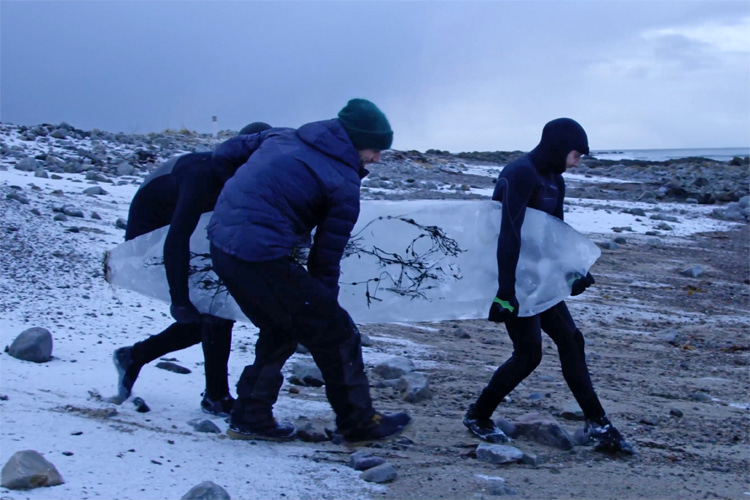
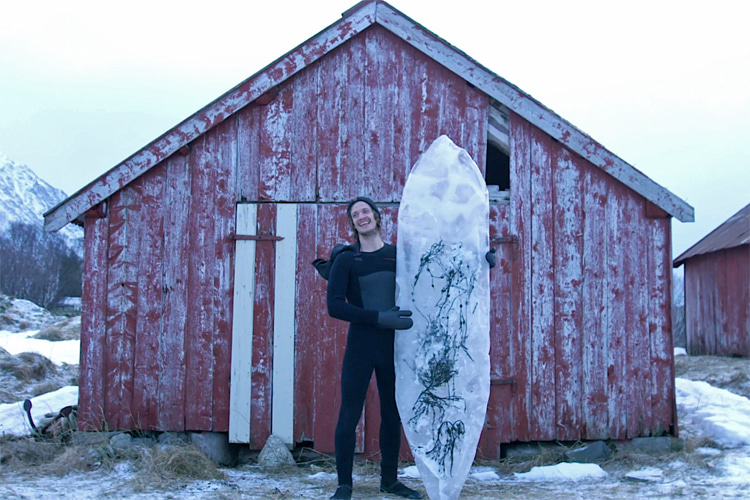
In 2019, Lofoten-based filmmaker Inge Wegge shot "Ice Edge," a short movie about a Norwegian collective trying to shape surfboards made of ice.
The team included seasoned surfers, a professional ice sculptor, and a local shaper.
It was a trial-and-error process, as different shaping techniques had to be tested, and carving ice blocks above the Arctic Circle is not something anyone can do.
Nothing was ruled out: longer and shorter templates, finless and non-finless setups, the use of sand to increase grip, and even embedded LED lights.
Soon, they realized they needed around 20-30 frozen surfboards and a boat to carry them to the lineup and town surfers into the waves.
All of this is in -10 °C of air temperature that often feels like -25 °C due to wind.
At first, they tried cutting ice from frozen lakes, but it didn't work.
Then they made molds from plastic and wood, filled them with fresh water, added seaweed for grip, and some other things for fun.
They put the boards in a room at -25 °C for two days in a fishery before testing them in the waves.
They tried out the boards for four days, carrying heavy 70-kilogram creations to the water.
The boards lasted about 30 minutes in the 3 °C ocean water before melting away, with only about five minutes of good surfing conditions.
They needed extra help to push the heavy boards into the waves for enough speed to catch them.
This kind of surfing is riskier than regular surfing because falling onto a 60-70-kilogram ice board can hurt.
After several days of trying, they nailed it, making ice surfboarding a reality.
Wakesurfing with an Ice Board in Minnesota
In 2021, professional ice sculptor Trevor Pearson fulfilled a dream: to shape a surfboard from a single piece of ice.
He meticulously designed it to resemble the shape and dimensions of a traditional surfboard, making it slightly larger to enhance water displacement and improve riding stability.
The thickness of the ice board was also considered to ensure it could withstand a surfer while balancing weight and buoyancy.
The experiment took place on a day when the ice had just melted on Eagle Lake in Minnesota.
Trevor and friends took the wake boat out, put the two and a half to three-inch thick board in the water, and realized it held up surprisingly well.
Their only enemy was temperature.
Trevor's experience on the ice board involved a delicate balance between staying upright and monitoring the board's condition.
As he rode, he had to assess the thickness of the ice beneath him, noticing it gradually thinning with each run.
The board was melting. Despite the inevitable, Trevor managed to navigate the ice board for a while before it eventually snapped in half.
The 50-pound Transparent Surfboard
In April 2024, professional wakesurfer Sam Studee challenged local company Minnesota Ice to shape a wakeboard out of frozen water.
The result was two 50-pound transparent boards swiftly tested in a nearby lake's cool waters.
The ride was a success; he was literally surfing on water, even though the boards melted and broke in half in 30 seconds.
How did Studee not slip? The real-life Cody Maverick drilled screws through his shoes for traction.
Words by Luís MP | Founder of SurferToday.com
por Surf News | Headlines and Top Stories https://ift.tt/eNBVtrq