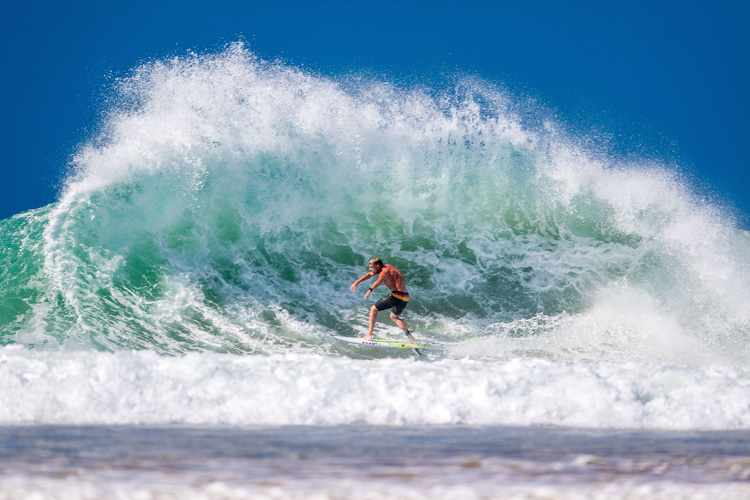
Surfing is all about working the unbroken wave face and maximizing riding time. But how can you optimize and balance these two goals that cancel each other out?
Many things separate a beginner surfer from a pro surfer.
However, there is one that stands out immediately after each one takes off on a wave - the way they draw a line or trim it.
Unlike a snowy mountain, a wave is in constant mutation.
As a result, surfers have to adapt their riding to the shape and breaking of each wave differently, whether they're going left or right.
Drawing a line on a wave is choosing the ideal path or trajectory to get the most out of the clean, open face and riding for the longest time possible.
Naturally, if you're spending too much time on cutbacks, off-the-lips, and carving maneuvers, you'll lose the "train," i.e., you'll get caught by the whitewater and end your ride prematurely.
Waves don't wait for surfers. They're on their mission.
So, it's up to surfers to read them, adapt, make the necessary adjustments in real time, and then expect to squeeze the waves' potential to the end.
In other words, a perfectly ridden wave is all about timing the surfer's speed to the natural behavior of the moving water.
A common rule of thumb in surf coaching states that the difference between a beginner and an advanced surfer is the line drawn on the wave.
Vertical Surfing
A first-timer will draw a straight line from beginning to end, while an experienced rider will engage in the so-called top-to-bottom surfing.
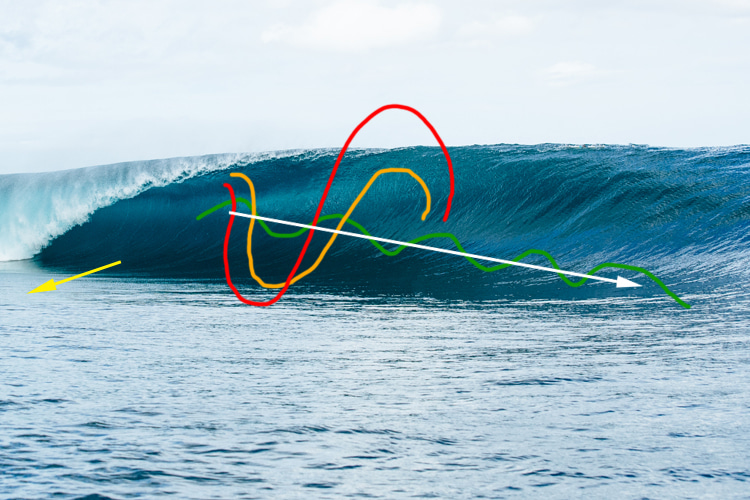
Let's put it visually:
The yellow line represents the novice, who will catch a wave and ride it straight toward the beach without making the most of its available space.
In the book "Secrets to Progressive Surfing," Didier Piter calls the rider of the white line a "passive surfer."
"The surfer rides the wave's face passively sideways in a linear trajectory called 'trim line,' which enables him to keep balance," notes Piter.
"At this stage, the surfer uses the speed and energy provided by upward motion in the wave face. He uses more of the wave's energy and extends his trajectory over more of the wave."
This straight line could be easily improved by applying pressure on the inside rail, releasing pressure, and then applying it to the outside rail.
The result will resemble a horizontal, stretched S-line that sees the surfer generating speed across the wave face, as shown in the green line.
Experience will bring more dynamic and vertical, top-to-bottom surf.
At this stage, as seen in the orange line, sharper and more abrupt horizontal S-style lines will be drawn on the open wave face.
The surfers will start moving up and down the wave, taking the most out of the wave height, keeping close to curl and on the steepest section.
At the utmost level, represented in red, the line drawn on the wave will be a sum of extremes, going super low (trough) and super high (above the lip) and extremely tight and compact.
The advanced surfer is constantly compressing and uncompressing the body and shifting their body's weight in the right direction, driving off the bottom and eyeing the lip for vertical hacks.
Managing the Moments of a Ride
The concept of top-to-bottom surfing does not necessarily apply to every wave and every moment of the ride.
There are times when an advanced surfer has to choose a higher straight line, for instance, to find space inside the barrel.
And there are also times when a mid, curvy line is the right option to generate speed before launching into an air trick.
The only moment staying low on the bottom of the wave is the right choice is to set up an aggressive bottom that will slingshot the surfer to anything he wants to do next.
On a perfectly breaking wave, the surfer manages the space and time available, ensuring they never lose momentum and are always within close reach of the pocket, the main energy source in a wave.
Reading the ocean and choosing the right wave is, therefore, a prerequisite to advanced surfing.
"When paddling, reading the wave is mainly horizontal, to evaluate what it will do overall, to assess the speed and rhythm with which it will break," concludes Piter.
"Once up and riding, reading the wave also becomes vertical so that you can use the entire slope to execute maneuvers."
The ultimate goal of the surfer is to aim high and low, further and deeper.
por Surf News | Headlines and Top Stories https://ift.tt/bvqZF8L