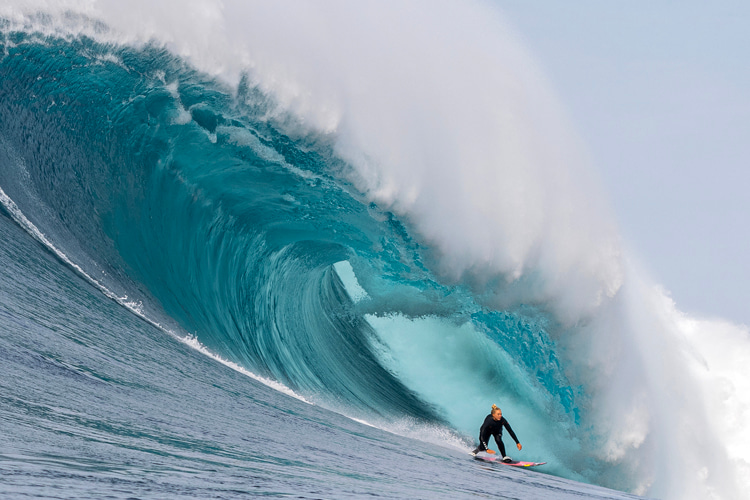
Big waves don't just appear out of nowhere. The formation of abnormally large swells is a sum of layers, normally invisible to the human eye.
They start their journey in the ocean thousands of miles away from the coastline, where powerful storms brew and transfer their energy into the ocean in the form of groundswells.
Meteorologists, weather forecasters, and surfers alike closely monitor satellite data to monitor the development of these swells.
Four key elements come together to create massive waves:
- Wind speed;
- Wind duration;
- Fetch;
- Bathymetry;
When strong winds blow over a vast stretch of ocean for an extended period, they transfer their energy into the water, generating XXL swells.
So, if you get a 60-mile-per-hour (96-kilometer-per-hour) wind blowing nonstop for five days over 2,000 miles (3,218 kilometers) of ocean, you've got two good ingredients ready for the big wave cake.
Once generated, these wave trains travel thousands of miles across the ocean, gaining momentum along the way.
But how does wind energy translate into waves? And can they reach incredible heights only on some surf breaks?
Imagine the ocean's surface as a vast playground where the wind pushes and pulls the water, creating ripples that grow into waves.
These surface waves carry the storm's energy across the ocean, building in size and power.
Some of these storm-generated swells will then encounter the perfect conditions near the shore to produce near-shore XXL waves at places like Jaws, Teahupoo, Mullaghmore Head, Shipstern Bluff, Todos Santos, Cortes Banks, Mavericks, Nazaré, and several other surf breaks.
However, before these humungous waves break, they need to harness energy as they make their way to the beach.
The Slinky Effect
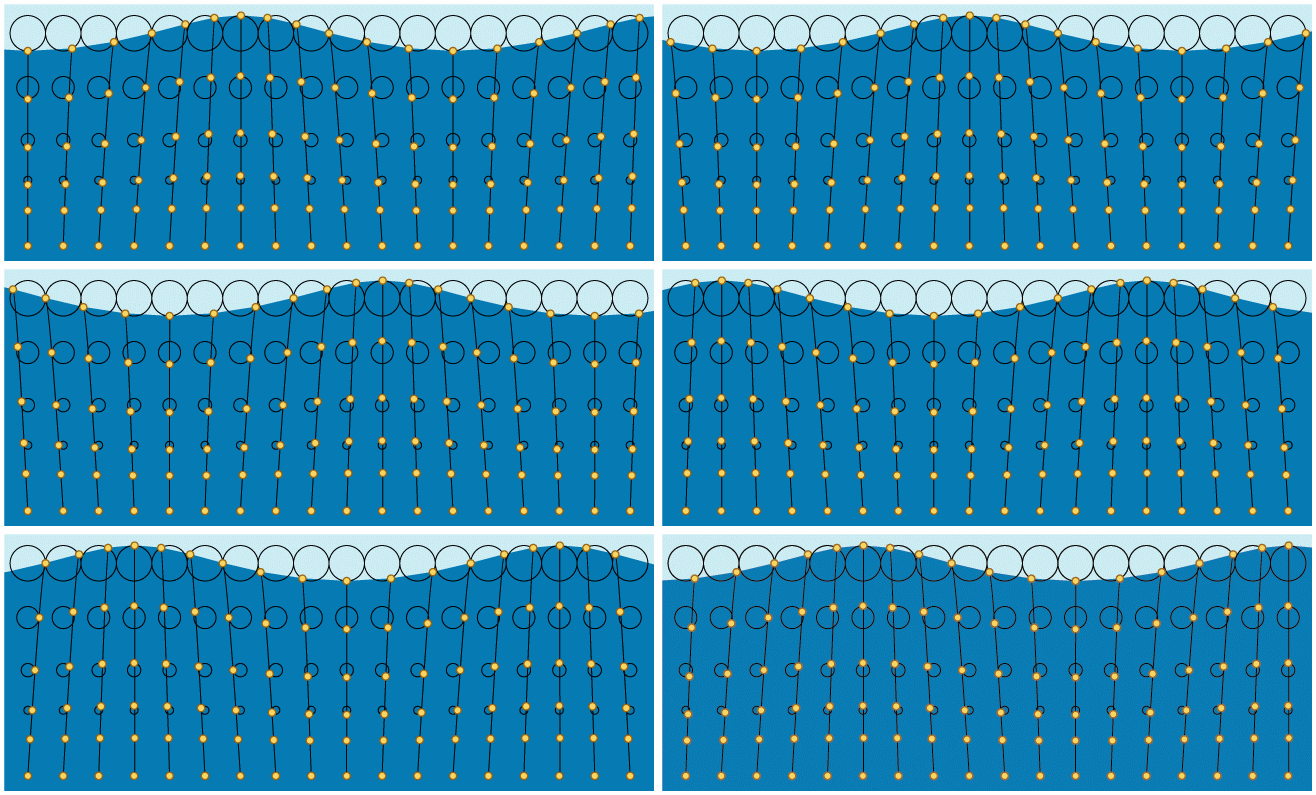
In deep water, even when the wind stops blowing, the amount of energy in the wave is fixed and conserved.
Now, the energy travels, but the water itself does not. The water is moving in a small circular motion, like if you play with a Slinky.
You can take it and flex it, and you can see that wave motion going up and down, but the metal or plastic part only moves a little bit.
If the wave energy below the surface reaches the bottom, the seafloor acts like a speed bump, slowing the wave down.
The exact amount of energy then gets compressed as the wavelength decreases. The only place for that energy to go is up, and the wave height intensifies.
All of the energy for that wave will be stored between the surface and a depth of about half the wavelength.
When the ocean depth reaches about half of the wavelength, the wave transforms into a shallow waterway.
So, as these large swells cross the ocean and reach the shore, they encounter various obstacles and features that shape their size and intensity.
One crucial factor is the underwater topography, or bathymetry, which determines how waves behave as they approach the coastline.
As the wave encounters the bottom and rises, its potential energy is converted into powerful kinetic energy that finally explodes as a breaking wave.
Channeling Energy: The Role of Underwater Canyons
In some regions, underwater canyons act as natural amplifiers, funneling wave energy into a concentrated force.
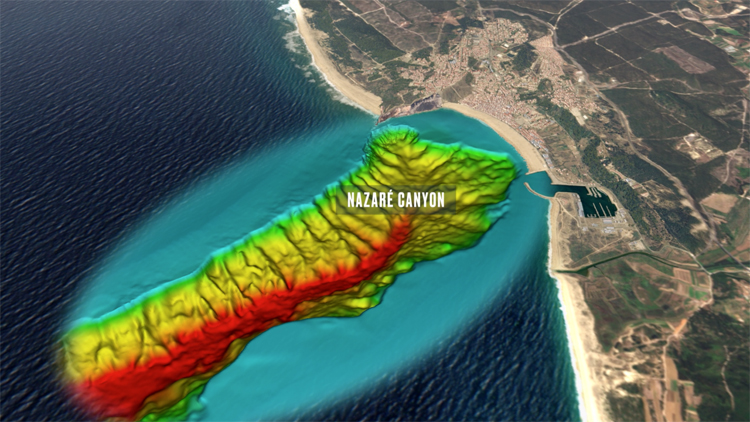
Take, for example, the Nazaré Canyon off the coast of Portugal, carved by ancient rivers and tectonic activity.
As waves enter this 230-kilometer narrow canyon, their energy becomes focused, creating the perfect conditions for giant waves to form.
Even though the underwater canyon is very deep, the waves have yet to touch the bottom, so they don't slow down.
Also, the energy from waves moving near the edges of the canyon gets pushed inside, making the waves even stronger.
The seafloor rises sharply near the shore, acting like a wall that squeezes all the wave energy.
It's like blocking most highway lanes so all the traffic goes through just one.
Refraction and Amplification
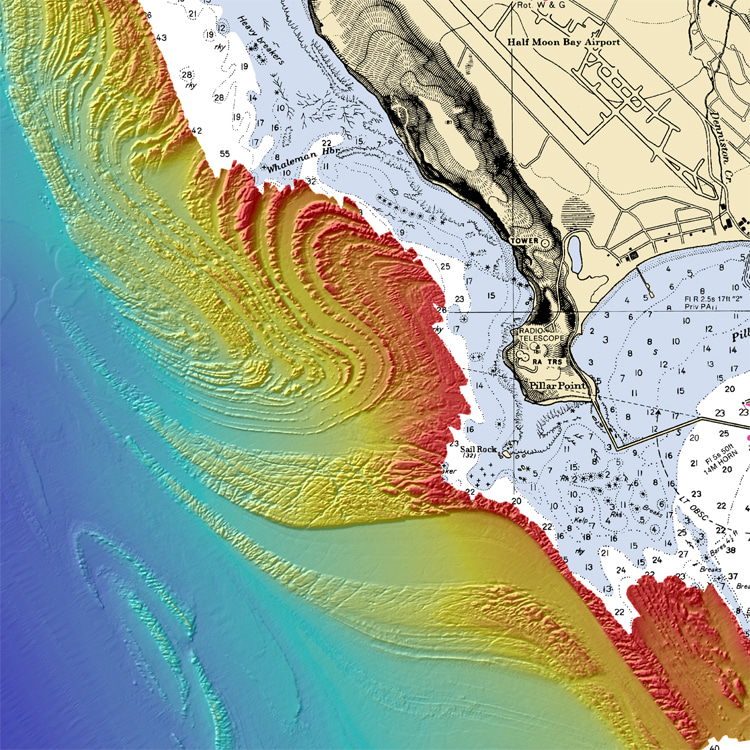
Near the shoreline, the seafloor rises abruptly, creating a natural barrier that compresses the wave energy.
This phenomenon, known as refraction, bends the waves and focuses/converges their energy into a single point.
At spots like Mavericks in Half Moon Bay, California, underwater reefs further amplify the waves, transforming them into towering walls of water.
Finally, the moment arrives when the waves unleash their full fury upon the coastline.
As they approach shallow waters, the waves slow down, causing their height to increase dramatically.
The energy stored within the wave reaches its peak, culminating in a breathtaking display of power as the waves come crashing down.
When these monster waves collide with the shoreline, they can literally shake the very foundations of the Earth.
At Mavericks, the force of the waves is so immense that they shake the North American Plate itself and get recorded on seismographs.
por Surf News | Headlines and Top Stories https://ift.tt/gKnhjxP