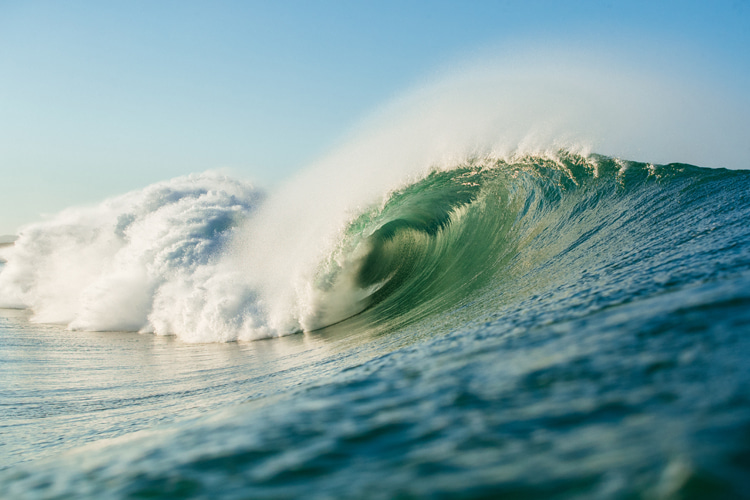
Is there any correlation between warmer or colder ocean waters and bigger waves? What is the influence of temperature on wave height?
When we think about power swells, meteorologists and surf forecasters look into the intensity of low-pressure systems on large oceanic fetches.
Then, they track waves generated thousands of miles from the coastlines and follow their energy-gathering pattern as swells travel toward the shores.
The intensity, duration, and area over which wind blows over the water's surface will dictate the power of a groundswell.
Nevertheless, these are only the essential wave train formation variables.
The existence, for instance, of an underwater canyon near the coastline can then dramatically boost the size of near-shore breaking waves.
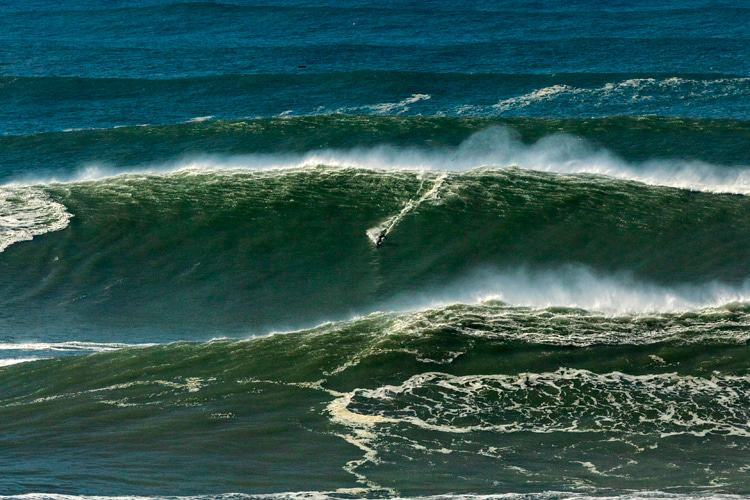
One of the best examples is Nazaré's Praia do Norte, where local bathymetry plays a critical role in creating XXL waves.
Poles vs. Equator
But what happens when water temperatures increase?
Is there a difference in wave size or behavior in warmer climates where you can surf without a wetsuit?
Does a wave pool in England perform differently from one in Abu Dhabi? What exactly is the influence of temperature on the life of a wave?
When we look at the map of the world's biggest waves, there's not enough statistically relevant data we can extract to reach a conclusion.
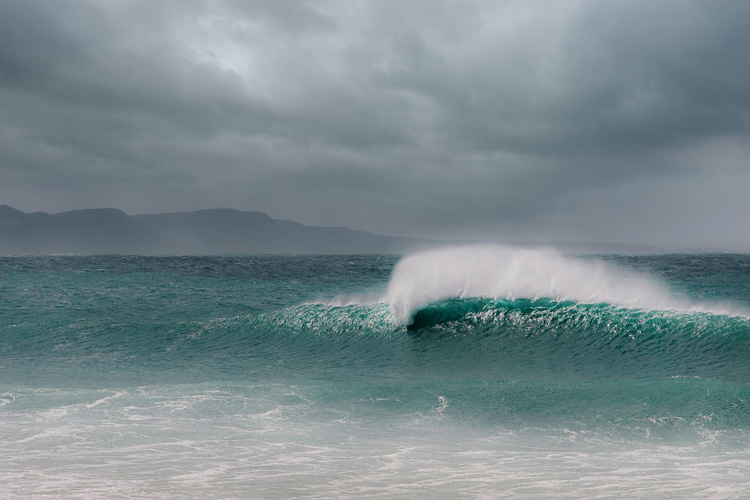
Yes, there are big-wave surfing spots near the Equator line - Jaws/Peahi and Puerto Escondido - but we also have other extreme surf breaks closer to the poles - Mullaghmore Head and Shipstern Bluff.
Also, because of their different surrounding environments and bathymetric characteristics, it's impossible to establish any conclusion or correlation.
Temperature and Density
The only option is to ask science, and the answers are pretty straightforward.
When water undergoes heating, it expands, increasing in volume.
In other words, the greater the water's temperature, the larger the space it occupies, leading to a decrease in its density.
On the other hand, lowering the temperature of water reduces molecular motion, causing molecules to come closer together and occupy a smaller volume, resulting in an elevation of density.
The conclusion is that heated water is lighter than the same volume of cold water.
What about speed/velocity? Does warm water travel faster than cold water?
Does hot water move faster than cold water?
Oliver M. Sun, an oceanographer at the Naval Undersea Warfare Center in Newport, Rhode Island, says it does.
The researcher wrote on the Physics Forum, "The speed of a wave in water is directly proportional to the temperature of the water."
"As temperature increases, the speed of the wave also increases."
"This is because warmer water molecules have more energy and can vibrate faster, causing the wave to travel faster."
Sun notes that "as temperature increases, the wavelength of a wave in water decreases because the speed of the wave increases, but its frequency remains constant."
"This results in a shorter wavelength."
Nevertheless, temperature is not a primary, critical factor in wave velocity.
The speed of water flow is mostly determined by external factors such as the force applied (wind or a wave pool pump), the slope of the surface it is flowing on (sandbanks or reefs), depth, and any obstacles in its path (rocks or islands).
It's worth noting that hot water can appear to flow faster than cold water under certain conditions due to differences in viscosity and density.
Hot water generally has lower viscosity and density than cold water, which means it may flow more easily.
You can witness it, for instance, by observing the flow of liquids in pipes or containers.
Global Warming and XXL Wave Events
Now that we've confirmed that warm water has more volume, occupies more space, and moves faster when compressed than cold water, it's time to dissect the impact of temperature on wave height.
The study of this combination of variables could help weather forecasters and surfers learn more about the ocean's behavior.
However, this unique relationship has never quite been the focus of attention and research from the scientific community.
Never - until recently.
Interestingly, the correlation between warmer world oceans and an increase in wave height is only indirect.
First, let's understand why it is not direct.
"The amplitude of a wave in water is not affected by temperature," Sun stresses.
"Amplitude is determined by the amount of energy that the wave carries, which is not affected by temperature."
"However, changes in temperature can affect the height of waves, which is a measure of their amplitude."
"This is because changes in temperature can cause changes in wind patterns, which can result in larger or smaller waves."
Precisely.
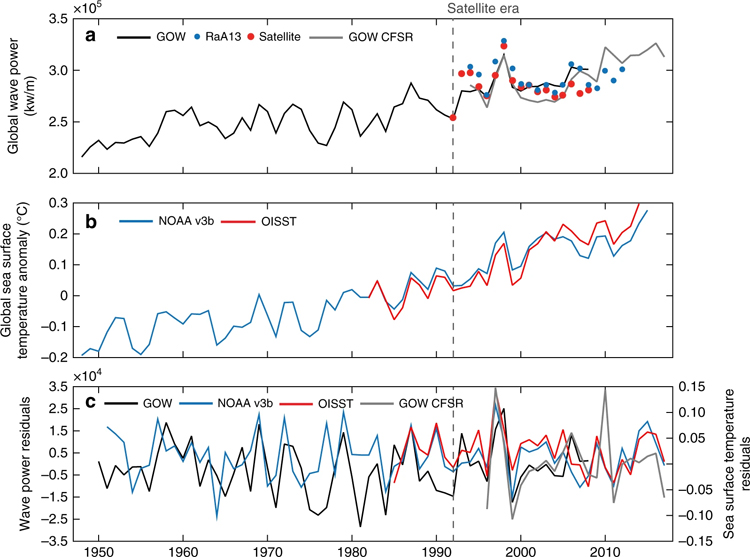
In 2019, Borja G. Reguero, an associate professor at the University of California, Santa Cruz, released the conclusions of a study titled "A recent increase in global wave power as a consequence of oceanic warming."
The study analyzed a potential correlation between the evolution of wave power in the world's oceans and global sea surface temperature from 1948 to 2008.
The results indicate that both variables are strongly correlated.
"The effect of climate change in oceanic warming has been increasing the global energy transferred from winds to the waves represented in the GWP," Reguero concluded.
"The impact of climate warming on the wave climate can therefore be seen in the energy transported by the waves, measured through the global wave power as a long-term signal of climate change."
In other words, the increase of surface sea water temperature results in stronger winds, which in turn mean bigger and longer waves.
por Surf News | Headlines and Top Stories https://ift.tt/zPgjTNC