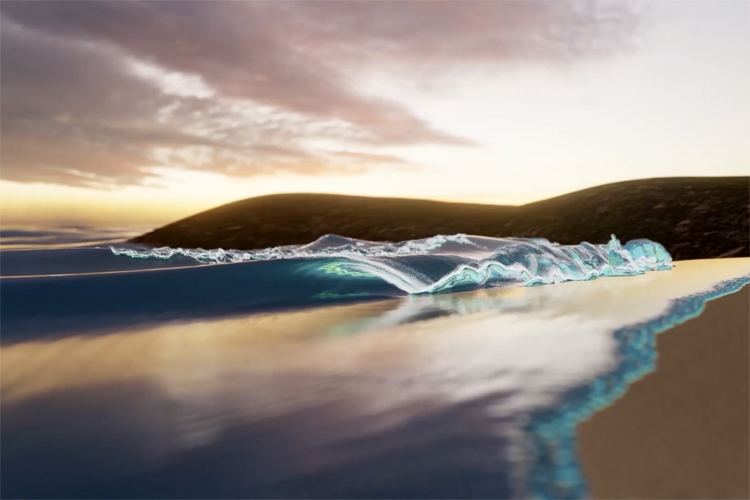
Robbie Crawford calls himself a multimedia specialist, but he's certainly more than that. Meet the 21st-century digital artist who has dreamed of waves since childhood.
He's been pushing the boundaries of graphical 3D wave simulation and sharing the developments with the world in the form of art and creative imagination.
Robbie is also a surfer and passionate lensman, two sides of his personality that surely help us understand his extremely popular work in social media.
However, the Huntington Beach-based imagery creator is not your typical professional surf photographer or videographer with a creative, hipster-driven vein.
Crawford operates mainly on the side of fantasy.
In the past couple of decades, the Californian has significantly contributed to establishing the compact action camera as a legitimate tool in professional media.
With the experimentations made with standard waterproof shooting devices showcasing their capabilities and features, Crawford's work has been featured in diverse media outlets such as the Discovery Channel and Thrasher Magazine.
More recently, Crawford started unveiling some of the results of his interactions with generative Artificial Intelligence (AI) software and programs like Midjourney.
His literally fantastic digital creations involve surfers and waves in hallucinogenic visions and LSD-inspired trips.
Robbie's supercomputer-based work around 3D environments, ultra-slow motion shots, virtual reality, and AI-immersed realities is unique and unparalleled in the surfing world.
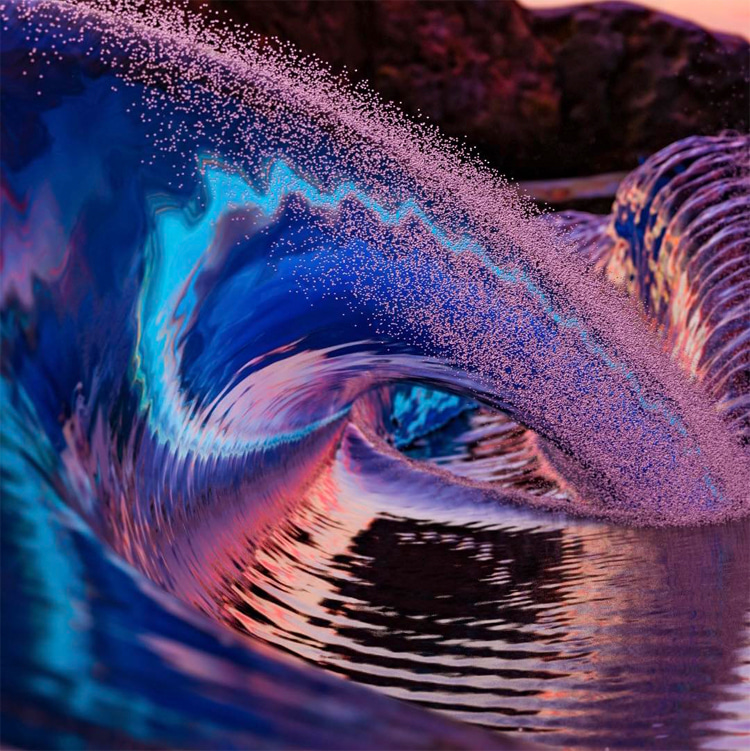
Volumetric Video Waves
Crawford is fascinated by waves and their natural motion from birth to whitewater.
The fact that he "missed the glassy days in the summer when the sun is perfectly positioned in the tube" inspired him to "figure out how to make the 3D wave simulations."
Crawford vigorously defends his digitally-backed art.
"What some people don't get is that art doesn't compete with reality - art compliments reality," Robbie wrote on his Instagram account.
"It's real-world experiences that drive artists to translate feelings we have toward certain subject matter to a medium. These aren't fake waves - they're real art driven by a true love for the ocean."
While you can witness a progressive evolution of AI-supported creations in Robbie's work through time, there is something that captivates everyone's eyes - the 3D perspective of a wave.
In the real world, the motion nature of waves never quite allows us to pause them and look at their beauty from all possible angles.
It is nearly impossible. You’d need a multi-axis array of cameras at the right place and time shooting the passing and breaking of a wave.
However, thanks to the ever-growing technological advances, three-dimensional views of an ocean wave are now, shall we say, virtually real and possible.
And Robbie Crawford is enchanted by this possibility.
"If I took people on a trip around the volume of a single frame of one of my wave simulations, it might better convey what they actually are," added the digital artist.
"When I create them, I'm not really making them for cellphones. I'm creating them with a future vision when they can be translated volumetrically into augmented virtual experiences."
Crawford stresses that each simulation is so complex that it takes around 100 to 200 GB of data.
According to the multimedia magician, "we will have the ability to turn traditional media volumetric" by the end of the decade.
Can you imagine experiencing volumetric video of waves and swells using augmented reality (AR) headsets?
The 3D image contemporary artist even imagined and designed a wave pool with glass walls so people can see above and beneath the waves.
Computational Power for Seconds of Viewing Pleasure
But make no mistake: each rendering takes ages, and all mistakes have to be corrected and then re-rendered again.
This is something that takes time, patience, and up-to-date technology. All for a few seconds of viewing pleasure.
Water is a highly complex topic in the multimedia field.
The physics of ocean waves is one of the last uncharted territories of digital fluid simulation.
The behavior of a breaking wave has been simultaneously a mystery and challenge, for instance, for game developers and animated motion picture computer-generated imagery (CGI) specialists.
Despite progress in recent decades, waves always seem rather unrealistic on the big screen or in video games.
For his physics-based fluid simulations, Robbie uses Blender, a powerful and open-source 3D computer graphics software for creating animated films, visual effects, art, 3D printed models, motion graphics, interactive 3D applications, and more.
The evolution of Crawford's renderings is quite notable, but there's always room for improvement.
The Soothing Effect
Robbie Crawford's innovative digital artworks and cutting-edge multimedia content go beyond the contemplation.
They transmit a soothing effect and relaxing aura to the hundreds of thousands of fans who follow the Californian's creations on his Instagram space (@robbiecrawford).
The light, the hues, the speed and pace, the angle, and the journey into the heart of a wave - the tube - are somehow meditative and enthralling without ever losing appeal.
Next stop: 3D holograms of waves, please.
por Surf News | Headlines and Top Stories https://ift.tt/UWLnk25