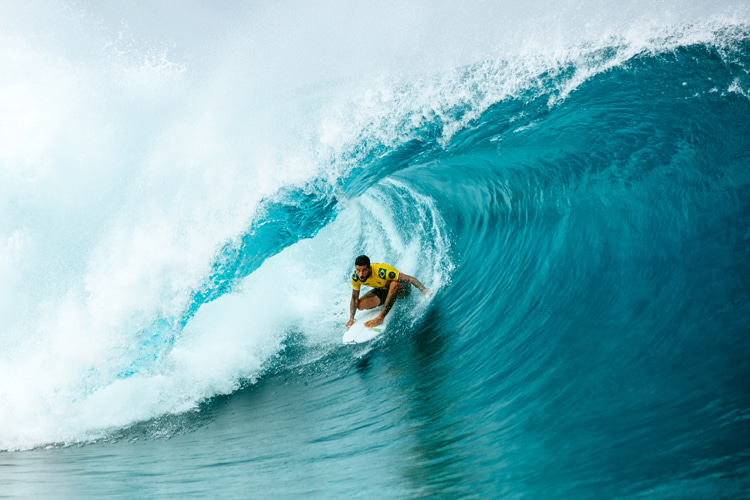
A father, husband, and family man with a past of mental health issues enters a bar. Everyone is drinking alcoholic beverages. He asks for a bottle of still mineral water.
Immediately after, the man hears insults; some question his masculinity, others his bravado. "If you don't drink a beer, you don't belong here."
Sigmund Freud's mob psychology is in full effect, and everything the man says is irrelevant and only fuels the crowd's anger and rage even more.
They don't want to know the reasons behind his abstinence. They just feel the need to judge him - for whatever he is, and he is not.
This could be the parallel story of Filipe Toledo.
Reality, though, may be a bit harder to cope with, especially in the social media-ruled world we live in.
The Brazilian committed a crime. Toledo withdrew from the 2024 Pipe Pro, citing illness.
And the public court was quick to react.
The Court of Public Opinion
Here are some of the comments that people were willing to make publicly about a fellow surfer:
"If it were the old rankings format, he wouldn't have won the world title."
- Fact: If it were the old rankings format, he still would've won;
"Food poisoning is healed with one pill."
- Fact: Most people need days to recover from food poisoning;
"He's a pro surfer, and he's being paid to surf in any conditions."
- Fact: Any professional in any field is free not to put their life on the line if they don't feel comfortable. Moreover, he's surfing and gets paid for his performance. Not the other way around. If he does not perform, he doesn't get paid;
"He is the best small-wave surfer in the world."
- Fact: Filipe Toledo has ridden the same size waves as any world champion on the CT;
The so-called surfing fans have a new favorite target for their everyday hate. It's a two-time world surfing champion.
But they're not alone.
It's also particularly self-explanatory to observe surf media outlets and inflated surf comedians fueling the social media fire around Toledo's performance at Banzai Pipeline.
The absence of interesting and relevant things to say or write leads people and organizations into embarrassing behaviors and publications.
And what's really interesting is that they all rely on other people's public disgrace or humiliation to get pageviews and ad revenue.
All hail surf culture's bible and clowns of the sport.
However, at the end of the day, if their sons, daughters, mothers, and fathers are put in a similar bullying situation, these people will move mountains to make justice.
"Oh, my children. Oh, my old parents."
Only a Surfer Knows the Greediness
Sadly, respect toward the other has never been something I expected from surfers in general.
I've been in the water for too long and seen it all. We're greedy and disrespectful, egotistic and narcissistic.
We see it every day in the lineup, and it is statistically relevant.
We are completely full of ourselves with no idea whatsoever of our own insignificance.
If people commenting on social media on Filipe Toledo's decision to withdraw from the 2024 Pipe Pro watched a clip of their own performance on an average wave, they would be embarrassed to even call themselves recreational surfers.
And what if Filipe is scared of big waves and hitting the reef? So what? Is fear a personal characteristic that excludes one from being on Tour?
Is the Championship Tour (CT) supposed to be a Big Wave circuit?
Do athletes need to compete in the most extreme and dangerous ocean conditions to become world surfing champions?
Do we really need to see necks broken and skulls opened at a professional surf contest?
Are weekend warriors now supposed to throw scores at competitors? Who decides the best surfer each season? Is it the public who has never paddled out at four-foot Pipe?
Are all CT surfers supposed to be equally good in all conditions? Since when is that in the rule book?
Since when is a world champion supposed to always do good at Pipe and Teahupoo?
The Fear of Having Fear
The list of professional surfers, including world champions, who had to improve their barreling skills, backhand game, or aerial antics is endless.
All professional surfers feel fear.
Fear keeps us alive. It's a body mechanism that keeps us alert and out of danger. It's self-preservation, and each one of us has its own.
People who don't feel fear are not brave.
Can you manage and work on your fear to handle it better or push yourself a bit more? For sure.
I have an irrational fear of spiders, needles, dogs, and heights. I am working on them, but it's a very slow and, who knows, endless process.
And, as a pro surfer, how can you ever become a world champion if you're the bravest, fearless tube rider but can't carve or unleash your air game?
We've seen Kelly Slater pulling out of competitions without questioning his reasons, but now we're 100 percent sure (because we live with Toledo's family) that Filipe pulled out of Pipe not because of food poisoning but because he's afraid of big waves.
We've seen surfers intimidated by crowds at the Rio de Janeiro CT stage.
Speaking of fear, here's something Slater shared with Forbes.
"I'm afraid of drowning and of getting a really bad injury on a shallow-water reef riding a big wave, both realistic dangers. Then, it just depends on how you deal with those fears. Sometimes, adrenaline and focus can help you overcome them. So it's assessing your fear, calculating it, judging it as best you can, and accepting the outcome."
The 11-time world surfing champion feels fear. Oh, the drama.
On January 2023, Slater also pulled out of the Eddie Aikau Invitational.
"Your ego gets in the way, obviously. But if you're not feeling it, you're not feeling it," the champion said.
"That's happened to me a few times on different swells over the years."
"There's been days where I just didn't feel comfortable with myself or my sleep patterns, or I hadn't big waves in a while, and so there are some swells I just don't surf, and today's one of those days."
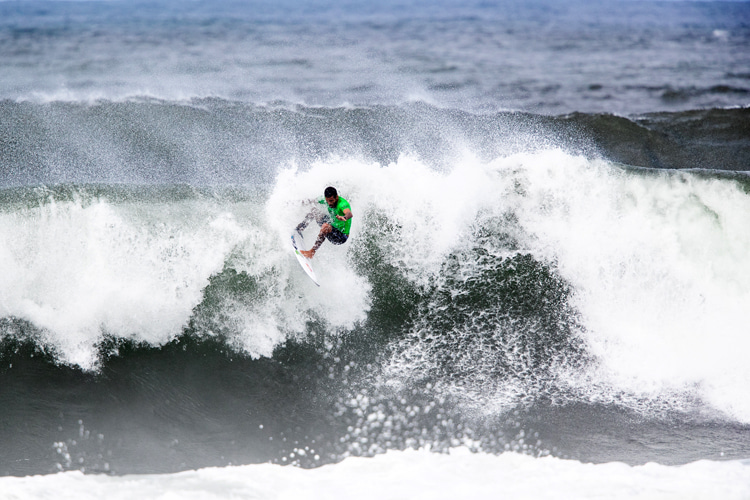
Filipe Toledo: From Teahupoo with Love
But with Filipe, our moral compass changes.
We, the judges. We, the people with opinions that really matter.
And if this melting pot of surf culture wasn't already toxic, the silence of Toledo's CT peers says it all. Solidarity - (almost) none.
Fortunately, one relevant voice was heard.
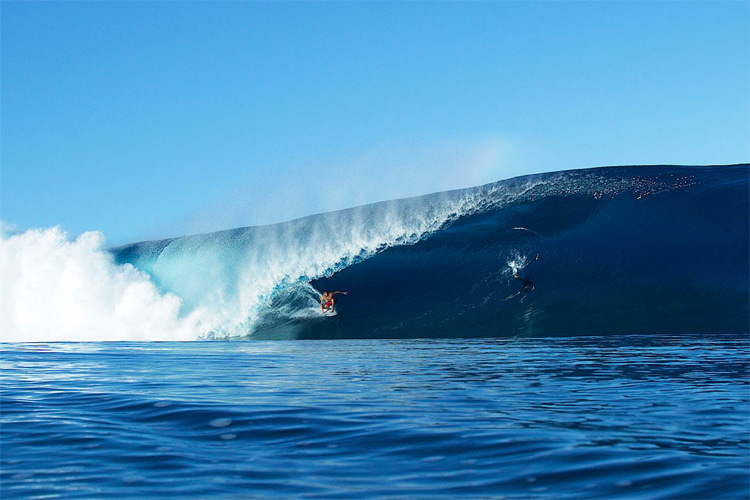
Tathiti charger Matahi Drollet dropped a picture of Filipe Toledo inside a huge Teahupoo wave with the following words: "99 percent of the people commenting here wouldn't even catch this wave."
It sometimes feels like we don't deserve to have a competitive circuit and that, maybe, WSL is the least problem pro surfing has.
No one has to prove anything to anyone.
At the end of the journey, if we're lucky enough to look at ourselves in the mirror and reflect, it'll be all about what type of person we were and how good or bad we were to our peers.
However, something tells me the Brazilian will have a word at the Olympic reef break.
A word for the 21st-century keyboard surfers-opinion-makers and a medal for his children and family.
Words by Luís MP | Founder of SurferToday.com
por Surf News | Headlines and Top Stories https://ift.tt/pe40l3j