Pular para o conteúdo principal

Depression Louis triggers historic XXL swell in Nazaré

Nazaré, Portugal: Depression Louis might have generated a new big wave surfing world record | Photo: Estrelinha/Praia do Norte

Depression Louis brought some of the largest swells of the decade to Portugal, Spain, and France, courtesy of the North Atlantic winter storms.

The extreme weather event raised national alerts and put big-wave surfers on hold on Europe's infamous XXL surf breaks.

Most storm-chasing fraternity converged in Praia do Norte, Nazaré, for another go at the Guinness World Record race.

The Portuguese underwater canyon has been the gold mine of many athletes and media professionals eager to ride and capture the sport's superlative stunts.

The Code Black swell brought a lot of wind, gusts, and heavy rain but also plenty of record-breaking opportunities for the usual suspects.

Three names in particular have been making a living in Nazaré in recent years: Lucas "Chumbo" Chianca, Sebastian Steudtner, and Rodrigo Koxa.

Whenever Praia do Norte fires its most brutal missiles, they're either strapped to their surfboard or towing someone into the massive avalanches of water.

The big wave surfing business has become a niche industry in the once quiet and picturesque fishing village.

Extreme surfers get the most out of the winter season the best way they can - free surfing or competing in events like the Nazaré Big Wave Challenge or the Gigantes de Nazaré.

The former is run by the World Surf League (WSL), and the latter by Brazil's TV Globo.

Gigantes de Nazaré is an invitational event that explores the monetization of online video content and broadcasting to large TV audiences.
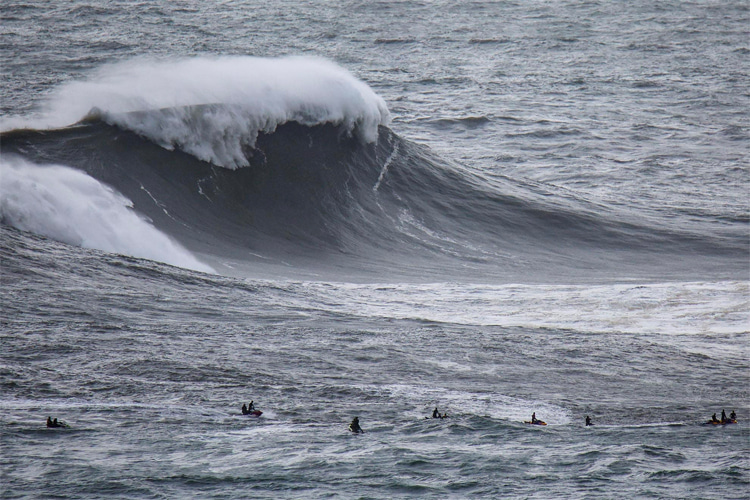
Praia do Norte: the underwater canyon firing scary avalanches of heavy water | Photo: Estrelinha/Praia do Norte

A Potential New World Record

On Saturday, February 24, Nazaré witnessed the peak of Depression Louis, with the beach break detonating 80-foot plus (25-meter) walls of water.

Chianca and Steudtner had an informal duel in the heavy waters, with both the Brazilian and the German entertaining the audience at São Miguel Arcanjo fort and on the cliffs with some impressive runs.

They were towed into the biggest waves of the day by Ian Cosenza and Eric Rebiere.

Some say the current 86-foot (26.21 meters) world record wave has been broken, but no one dares to say by whom and on which wave.

The WSL officials will have the last word, using their fine-tuned wave height measuring method.

Once again, the safety rescue teams were busy driving jet skis around massive whitewater and backwash waves and taking their partners out of the impact zone.

The striking 360s and double backflips are becoming the playful standard for foot-strapped surfers descending long liquid slopes.

They're the signature tricks and bonus factor for the patient crowd watch from the safety of terra firma.

But surprises can happen, and throughout the week, as the swell's energy was building, other players emerged confident and audacious.

Lucas Fink, Balaram Stack, Eden Edwards, Alessandra Marinelli, Lourenço Katzenstein, Will Santana, Kalani Lattanzi, Michelle des Bouillons, Gabriel Sampaio, Manuel Fróis, and Vítor Faria also had their share of stoke.

They will definitely keep an eye out for when opportunity knocks.

The quest for the 100-foot wave is a work in progress, one that will require a flawless and rare combination of weather elements to take place.


por Surf News | Headlines and Top Stories https://ift.tt/upvjwEe

Postagens mais visitadas deste blog

Duke Kahanamoku reflects on surfing, Olympics, and old Hawaii in 1966 interview

Duke Kahanamoku is the most influential surfer of all time and is often hailed as the father of modern surfing. There is nearly no one questioning these titles. Recently, Public Broadcasting Service (PBS) Hawaii unveiled a never-before-seen interview with the legendary surfer and Olympic swimmer. In the 1966 episode of Pau Hana Years, a seminal Hawaii television program that aired on KHET-TV (now PBS Hawaii) for 16 years, running from 1966 until 1982, Bob Barker chats with Duke Kahanamoku, then 76. The conversation drifts from royal ancestry to Olympic lanes, from Hollywood sets to a surfboard shaped by hand, tracing the outline of a life that helped define modern surfing and Hawaii's public image in the 20th century. And if you know little about the man who dreamed of getting surfing into the Olympic Games, this is a precious piece of history. A name with history, worn casually The interview starts with Kahanamoku explaining that "Duke" is not a title but his giv...

The hydrodynamics of surfboard fins

Have you ever wondered why a surfboard fin looks like that? It is a single or a set of fixed blades or keels located under a board, near the tail, often no bigger than a hand. Yet that small surface is where much of the surfboard's behavior takes place. Speed, hold, looseness, and the feeling of control all trace back to how water moves around fins. The physics of surfboard fins falls under hydrodynamics, the study of how fluids behave in motion. So, according to science, they feature a shape designed to turn flowing water into several forces. Let's take a look at what's at stake when fins and water interact. Lift and the feeling of control One of the key variables in hydrodynamic terms involving surfboard fins is lift. When a surfer leans into a turn, the board tilts and the fins meet the water at an angle. The angle is enough to create a pressure difference between the two sides of the fin. Water speeds up on one side and slows on the other. The result is a sidewa...

How paddleboarding transforms your body and mind

Adventure is on our doorstep. With so many different bodies of water available to paddleboarders, from city canals to coastal routes, we can find adventure in places much closer to home than people might initially expect. According to the Canal and River Trust, 50 percent of people in England and Wales live within just eight kilometers of a canal or river, and eight million people live less than one kilometer away. I had lived within just a few kilometers of the Leeds and Liverpool Canal for years and never really explored it before stand-up paddleboarding (SUP) came into my life . The challenge created both a new perspective and a deeper love for where I lived and the areas which I passed through. On my coast-to-coast journey, I slept in my own bed for two nights as the route passed through my then hometown of Skipton, yet I felt I was on a grand journey of discovery. We are braver, stronger, and more resilient than we think. SUP not only helps us feel more connected to our va...