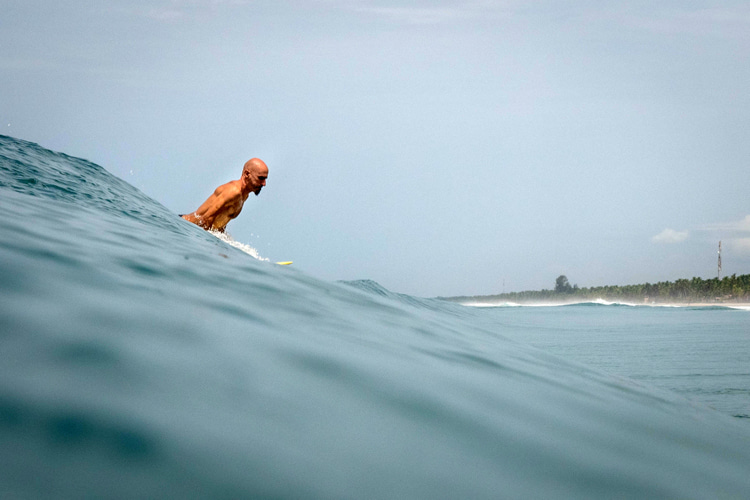
The pop-up is a surfing skill that will determine the ride's success. But where should surfers place their hands during this critical moment?
The take-off is everything. You'll either make it or lose a good wave.
Transitioning from a prone position to standing on the surfboard requires a fast and efficient body movement that involves the whole body.
The coordinated and nearly instinctive push should be performed precisely when the board enters the wave.
Are you a surfer who constantly analyzes their pop-up technique, wondering if there's room for improvement?
If so, we have relevant information for beginners, intermediate, and advanced surfers.
The following tips will help you improve your take-off performance and gain precious fractions of a second.
There are a few methods for positioning your hands during the pop-up. But are they interchangeable? Is it any better than the other?
Let's get a thorough understanding of the ideal hand placement for a successful pop-up, dispelling any doubts or misconceptions.
The Cobra Pose
The fundamental principle of hand placement during a surfboard pop-up is to keep it simple.
As a general rule of thumb, you must know that your hands should be under your shoulders and next to your chest.
The goal is to get a comfortable position that allows you to smoothly transition into Yoga's cobra pose, a crucial part of the pop-up.
How do you push up? Here are the most used methods.
1. Hands Flat on the Deck
The best way to pop up on a surfboard is by placing the hands flat on the board's deck at chest level.
Not only is it the most natural hand positioning for popping up, but it is also the best for getting even pressure distribution and stability over the board.
It's the most widely taught technique when learning to surf because it helps you achieve a balanced stance, maneuver the board, and generate speed efficiently.
But it also has a downside.
In more extreme conditions or late take-offs, it's harder to control the board, and you may need to grab the rails to keep the board close to you.
2. Gripping the Rails
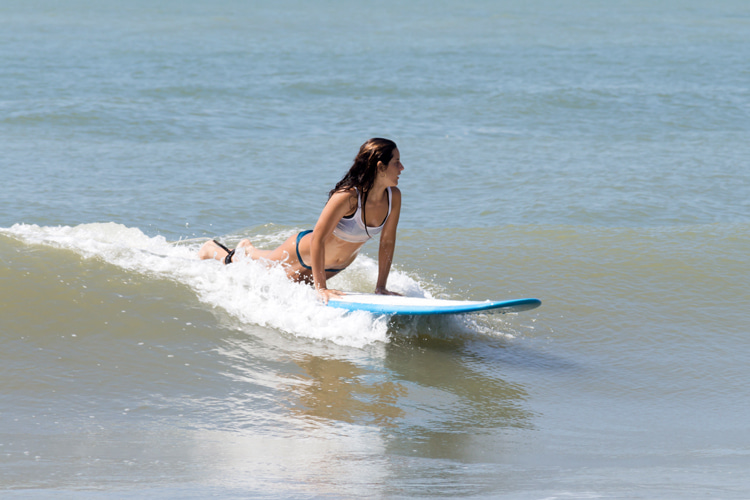
Grabbing the rails is the second most popular method for popping up on a surfboard. You can see it in action in nearly any lineup.
Although practical and comfortable, it has its downsides, so it should be embraced with caution.
Tight gripping can induce stress and uneven pressure during pop-ups, possibly affecting board control.
Holding the rails too tight could lead to disrupted water flow and potential balancing issues.
Last but not least, having your hands on the rail's edge makes it easier for the hands to slip off during the pop-up.
3. Slight Forward Front Hand Placement
Another effective hand placement involves placing your front hand slightly further forward, causing you to stand slightly forward on the board.
This position aids in rotation and twisting during the pop-up, making it easier to correctly position your front foot and angle the board the way you want to ride.
It can be beneficial for surfers who may lack hip flexibility, even though it is not very common.
4. Fist Pop-Up
A rarely seen technique involves using your fists to help you stand on the surfboard.
There is no apparent advantage compared with the hands flat on the deck technique, but it might feel more comfortable for some riders.
Practices You Should Avoid
There are a few behaviors you should avoid.
Placing your hands too far forward can provide stability and balance and drive down the wave, but it can lead to standing too far forward on the board.
This forward position may result in a wide stance, making it difficult to perform maneuvers. And pearling, too.
So, try keeping your hands closer to the chest.
Also, some surfers, especially those lacking upper body strength, resort to placing their hands further forward, putting their elbows on the board, and holding the rails.
This technique can result in dragging one or both knees forward, leading to a centered but less effective stance.
Surfboards may nose-dive in steep sections with this hand placement, so it's not recommended for most surfers.
If you struggle with upper body strength, it's essential to work on building your strength rather than relying on ineffective hand placements.
A centered and controlled position is essential, but it's achievable through improving your pop-up technique and building strength over time.
Ultimately, remember that keeping the surfboard leveled during take-off is crucial.
Overloading the tail or the front can lead to loss of balance or speed, especially when you're about to drive the board to surfing's fundamental maneuver, the bottom turn.
Proper arm extension during pop-up creates space under your chest, assisting in better foot placement and overall stability.
por Surf News | Headlines and Top Stories https://ift.tt/iaUN5dz