
Whether they're used in tow-in surfing or surf rescue, personal watercraft (PWCs) are an important part of wave-riding activities. Here's what makes the best jet skis for surfing.
Jet skis, originally termed "water scooters," made their debut in the 1950s.
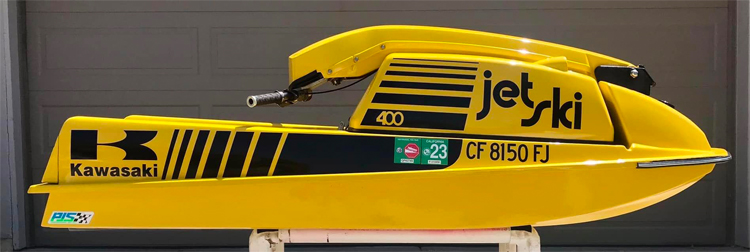
However, it wasn't until Kawasaki introduced its model in 1973, influenced by Australian Clayton Jacobsen's design modifications, that it gained widespread recognition.
These alterations included a change from a seated to a standing position for the driver, the introduction of an internal pump jet, and the use of fiberglass in construction.
The term "jet ski" is actually a commercial designation coined by the Japanese company for their first PWC model.
The JS400 was a stand-up jet ski powered by a two-stroke, two-cylinder 400cc engine.
Today, the personal watercraft market is bigger and worth around $1.5 billion. The best-selling jet ski brands are Kawasaki, Yamaha, and Sea-Doo.
Jet Skis in Tow-In Surfing
The concept of tow-in surfing emerged in the late 20th century when surfers sought to conquer waves that were previously unattainable through traditional paddling.
In the early 1980s, Philip "Flippy" Hoffman made the first search-and-ride experimentations at Oahu's North Shore outer reefs using an original stand-up jet ski by Kawasaki.
In 1987, Herbie Fletcher towed young Martin Potter into a huge Second Reef Pipeline wave using a stand-up PWC.
Pioneers like Laird Hamilton utilized PWCs to reach and surf waves ranging from 30 to 50 feet, a feat impossible with conventional methods.
Hamilton, Buzzy Kerbox, Dave Kalama, Mark Angulo, Darrick Doerner, Rush Randall, and a few others formed the "Strapped Crew," the collective who used water scooters to slingshot surfboards into waves that had never been ridden.
The first trials took place at Jaws, Peahi, in Maui, Hawaii. Initially, they used inflatable zodiac boats, but by 1993, Hamilton and company were already testing jet skis.
The initial models featuring motorcycle handlebars lacked thrust and were designed for riding flat lakes. Taking them to high surf was dangerous.
The innovative method of towing surfers into XXL mountains of water expanded the horizons of surfing but soon also sparked controversy due to the risks and environmental concerns associated with it.
The tow-in movement had its ups and downs, and the use of PWC in surfing activities followed closely.
The accusations of lack of sportsmanship led to a partial return to the paddle-in purity, and the lineups crowded with motor-powered engines led to no-jet ski legislation and bans.
However, the death of several big-wave surfers and the need for water safety patrols to monitor competitive arenas kept PWCs in the lineups.
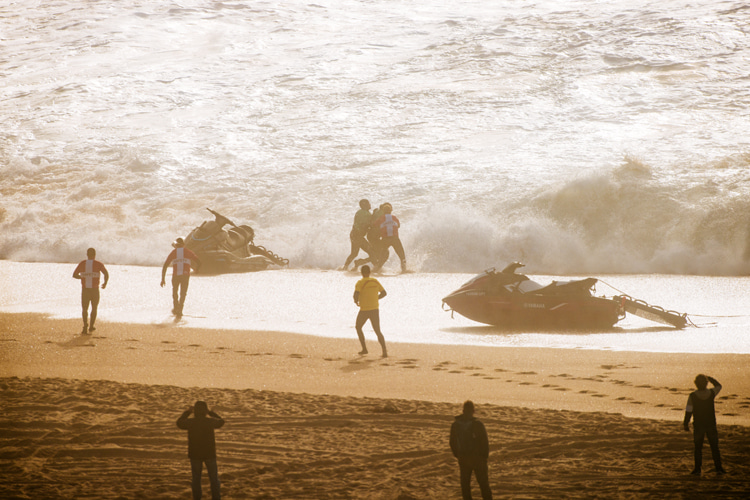
In recent years, jet skis have become an increasingly essential tool in the world of surfing, especially in surf rescue operations in big wave scenarios.
These powerful water vehicles have transformed the way surfers interact with the ocean, enabling them to tackle larger waves and ensuring increased safety in the water.
It's undisputable - jet skis have saved countless lives.
How a Big-Wave Jet Ski Works
A jet ski moves through the water using a simple yet effective mechanism.
At its heart is a small pump located within the hull, the body of the jet ski.
Inside this pump is a crucial component called the impeller, which is essentially a rotating fan.
When you're ready to zip across the water and press the throttle, this is what happens: the pump springs into action, drawing in water from beneath the jet ski through a special grate.
The impeller then gets to work, spinning rapidly and forcefully propelling this water out through a jet nozzle situated at the rear of the jet ski.
This process of shooting water out at high speed is where the magic of movement happens.
According to Newton's third law of motion, for every action, there is an equal and opposite reaction.
So, as the jet ski expels water backward with great force (the action), it propels itself forward (the reaction).
This not only moves the jet ski forward but also allows you to steer and maneuver it, giving you control over where you go and how fast you get there.
In essence, the more water the impeller pushes out, the faster and more agile the jet ski becomes.
The technical features evolved dramatically over the years.
For instance, in the past, the single impeller pump generated around 500 pounds of thrust. Today, double impeller models created 2,000 pounds of thrust.
Big wave surfers use several PWC brands and models in their big wave stunts. However, some characteristics are now shared by all, including:
- Fast acceleration;
- High maximum speed;
- Lightweight hull;
- 1-3 seats;
- Rescue sled with handles;
- Rubber-protected tow rope;
- The brake and reverse are controlled by the left handlebar lever;
Most of the jet skis used in surfing competitions and exploration cost between $7,000 and $20,000.
Jet Skis in Surf Rescue
Apart from their role in tow-in surfing, jet skis are invaluable in surf rescue operations.
Equipped with rescue sleds, these PWCs enable trained drivers, lifeguards, and first responders to swiftly reach and safely transport individuals in distress.
The incorporation of sleds in rescue missions proved PWCs' reliability, speed, and versatility in critical lifesaving scenarios.
An inflatable jet ski sled is an indispensable accessory for tow-in surfing.
These durable yet lightweight flotation devices, attached to the stern of the PWC, allow the jet ski driver to pick up surfers or swimmers with ease.
The selection of a jet ski sled should be based on its compatibility with the specific model of the PWC, as well as its performance in challenging conditions.
Attaching a rescue sled to a jet ski is a process that varies slightly depending on the manufacturer.
It is vital to follow the instructions provided by the PWC manufacturer and use only the designated attachments.
Typically, a rescue sled should have three attachment points on the stern of the jet ski, and the connections must be secure but not overly tight.
Rescue protocols have evolved greatly throughout the decades.
The Hawaiian Water Patrol is one of the most experienced professional high surf recovery teams in the world.
por Surf News | Headlines and Top Stories https://ift.tt/lcv4KJk