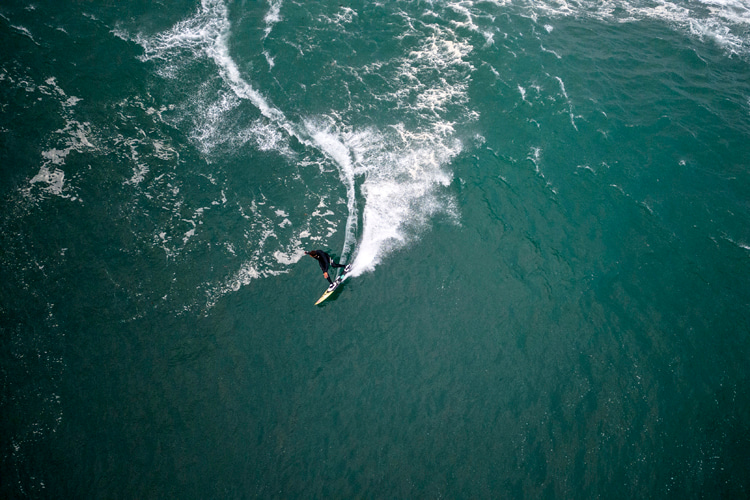
Of all the measurements that are often used to evaluate, analyze, dissect, and score surfing and surfers, there is one that is rarely mentioned - speed.
The size of a wave and the length of a ride are two very popular variables within recreational and competitive surfing.
Although they might not tell us much about a surfer's performance, they are certainly the most portrayed in mainstream media.
Who cares if a Guinness world record breaker wiped out or did not ride the whole wave from top to bottom?
If the wave is big, then that's the story that gets published. As with many other sports, surfing is also a matter of superlatives.
But why has (top or average) speed not been scrutinized more? Why isn't there a contest, an award, or a prize for the fastest surfer?
The truth is that there has been an attempt to measure and embed speed data into professional competitive surfing.
The First Need for Speed
In 2011, the late ASP World Tour introduced an innovative feature.
At the Quiksilver Pro Gold Coast, the tour invited athletes to embed a GPS device in the contest jerseys and record their speed on each wave.
Several pro surfers embraced the challenge.
The gadget powered by VX Sport weighed three ounces (85 grams) and was sewn into the competition shirt between the shoulder blades.
All data was wirelessly sent and analyzed in real-time on a computer.
A daily leaderboard showed who was in front, with the fastest male and female surfer taking home $2,500 each at the end of the event.
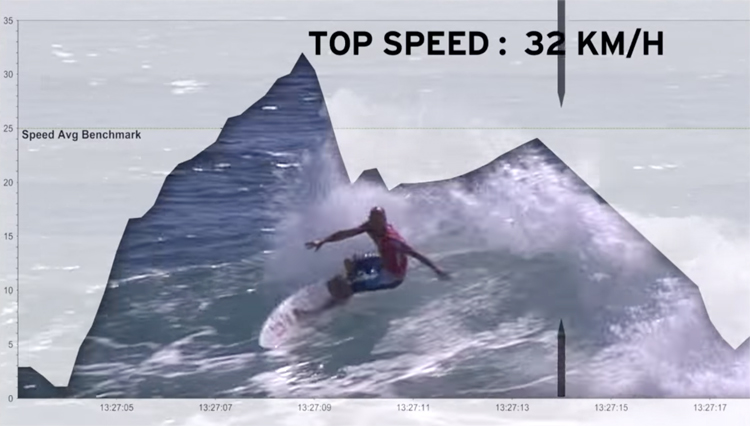
The 2011 Quiksilver Pro Gold Coast speed surfing results were as follows:
- Mick Fanning: 39.1 km/h;
- Joel Parkinson: 34.6 km/h;
- Bede Durbidge: 33.6 km/h;
- Kelly Slater: 32 km/h;
The non-compulsory innovation's original goal was to unofficially crown a speed champion.
"I think it's going to be great for the spectators just to add that excitement factor," Bede Durbidge expressed at the time.
"Everyone's sitting on the beach and wondering how fast everyone's going. It is going to blow people out how much work surfers actually do in a heat and how fast they've gone through their bottom turns, turns or even in the air."
"I reckon it'll be really good for training, especially working with your shaper and trying different boards because you'll be able to tell which board goes faster."
Durbidge's words sounded promising but despite the exciting results and the positive feedback from surfers, the ASP World Tour abandoned the trial.
Speed Surfing: A Late 1960s Trend
As we've seen above, speed was never a variable that picked up enthusiasts in professional competitive surfing.
However, the late 1960s had a curious wave-riding concept going around for a short period.
It was called "speed surfing."
According to surf historian Matt Warshaw, speed surfing was a kind of subdiscipline "in which the surfer crouched while keeping the legs nearly locked together, and essentially rode the wave as if it were a downhill ski run, with long, fast, gradual turns."
"Speed surfing was developed by three-time Makaha International winner Joey Cabell of Hawaii, a competitive downhill skier in the early and mid-1960s."
"During the first few months of the shortboard revolution, Cabell returned to the beach and applied his ski techniques to the newly streamlined 'pocket rocket' surfboards."
Joey Cabell quickly convinced a few surfers to try the new technique, including California surfer Dru Harrison, who learned to adopt the ski, "and it put me onto the most righteous surf trip of my life."
However, according to the author of "The Encyclopedia of Surfing," "waves aren't mountains, and most top surfers understandably couldn't resist doing the big, sharp, flashy turns that were anathema to the speed surfing method; Cabell's technique was passé by 1971."

Big Wave Surfing's Fast Rides
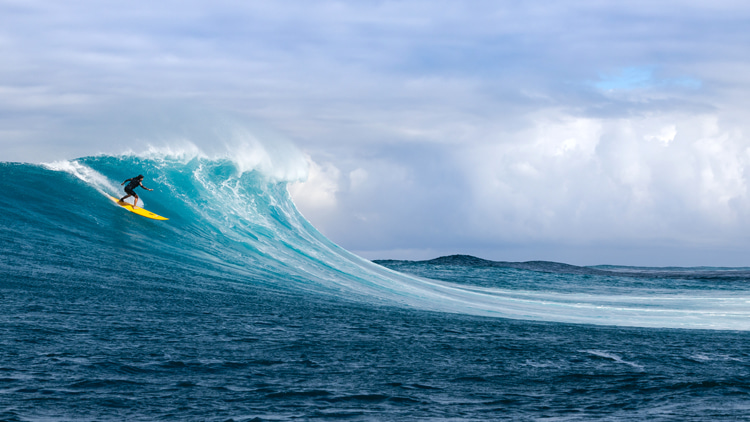
The speed a surfer reaches increases with the size of the wave. The bigger the waves, the faster the surfer will ride it.
Several experiments have been made with GPS devices in big-wave arenas.
In 2020, the Nazaré Tow Surfing Challenge welcomed a big-data trial by FlyThings Surf, a device developed by the Galicia Institute of Technology (ITG) that measures speed, distance ridden, the impact of a wipeout, G-force, and other variables in real-time.
The project had been started in 2016 in Spain and was first tested in the Pantin Classic, an iconic World Surf League event.
The goal was to show all data during the live broadcast replays of each wave ridden by surfers, but it quickly became a real-time feature.
So, when the device was tested in a big-wave surfing environment, spectators could check the stats live while the athletes performed at Praia do Norte.
The system recognizes the surfboard's three-dimensional movement with a capacity of 450 measurements per second until a detailed analysis in 4D is reached.
Its long-range radio communication system allows the retransmission of information in real-time, with a frequency of 50 measurements per second, recording 11 different variables, as well as the surfer's positioning at each moment.
The spectator gets the speed, the distance ridden above the wave, the strength and speed with which he performs each maneuver, and the power of impact he sustains in each maneuver.
"Watching a whole competition is really boring, and I say that because I've been practicing this sport for 27 years. If you have this type of content, you can keep the viewer hooked," explained Santiago Rodríguez, director at ITG.
The results taken from the 2020 Nazaré Tow Surfing Challenge were as follows:
Speed
- Benjamin Sanchis: 76.20 km/h
- Kai Lenny: 75.39 km/h
- Andrew Cotton: 74.43 km/h
- Alex Botelho: 70.93 km/h
- Mick Corbett: 70.03 km/h
- Rodrigo Koxa: 69.54 km/h
- Justine Dupont: 67.97 km/h
- João de Macedo: 67.81 km/h
- Nic Von Rupp: 66.63 km/h
G-Force
- Mick Corbett: 7.4
- Nic Von Rupp: 6.2
- João de Macedo: 6
- Rodrigo Koxa: 5.6
- Kai Lenny: 5.4
- Alex Botelho: 5.2
- Justine Dupont: 5.2
- Benjamin Sanchis: 4.7
- Andrew Cotton: 3.1
After reviewing the data, Kai Lenny recognized that "with these data, it is possible to develop water equipment adapted to simulate these conditions without being in the water."
"Big waves don't show up every day, and when it happens, you must be prepared as best as possible. This system has enormous potential for, one day, measuring wave height. For now, everything is an estimate."
"I would like to know how much weight falls on our heads and how much time we spend underwater. I want to know more."
Making Speed a Mainstream Statistic
Fans have been asking for more innovation and creativity not only in the surf industry but also in competitive surfing.
With the available tools and technology, a lot can be made to make the sport grow to a larger audience while keeping the core enthusiasts engaged and entertained.
Speed is already one of the most popular windsurfing and kiteboarding features and a discipline of its own.
The evolution of these wind-powered sports equipment reached unprecedented levels, with subtle and minimal adjustments and fine-tuning in constant mutation.
Putting world records on the line is a great way to boost public perception of a sport.
The fastest kiteboarder on Earth is Alex Caizergues at 107.36 kilometers per hour (57.97 knots); the fastest windsurfer in the world is Antoine Albeau at 98.65 kilometers per hour (53.27 knots).
When will surfing have their shortboard and big-wave surfing speed kings and queens?
Words by Luís MP | Founder of SurferToday.com
por Surf News | Headlines and Top Stories https://ift.tt/jFBkcrX