Pular para o conteúdo principal

Da Hui Backdoor Shootout: the anti-establishment surf contest

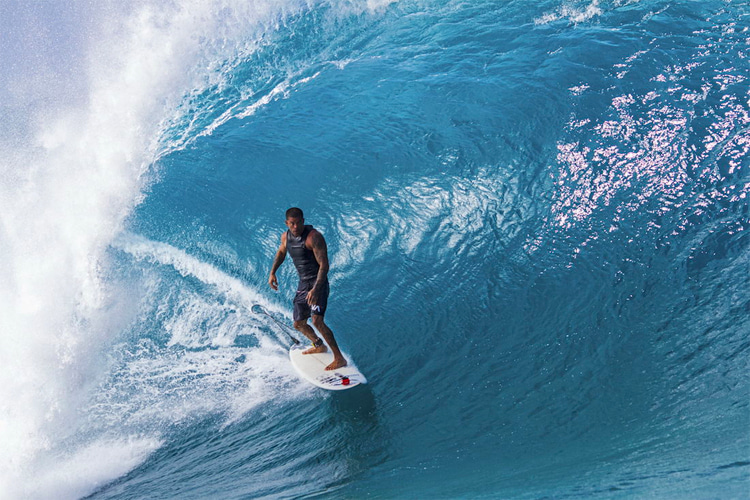
Da Hui Backdoor Shootout: a contest run by Hawaiian with Hawaiian rules | Photo: Hui O He'e Nalu

The Da Hui Backdoor Shootout is an alternative surf contest. The Hawaiian event subverts all the standard rules of competitive surfing.

If there's one thing that native Hawaiian surfers are proud of is their Polynesian culture.

The Da Hui Backdoor Shootout is a unique surfing competition created in 1996 and run by Hui O He'e Nalu.

The Hui O He'e Nalu is a nonprofit entity dedicated to the education, coordination, preservation, and support of Hawaiian activities and culture, aiming to promote their progress.

Distinct from the sister company Da Hui, which functions as a for-profit business, the Hui O He'e Nalu operates independently.

Da Hui originated in Hawaii, founded by a surf gang called the "Black Shorts."

These passionate native Hawaiians were dedicated to protecting and preserving Hawaiian surfing, unyieldingly defending it.

Their notable presence in the late 1970s, disrupting professional surfing contests on the North Shore by non-Hawaiians, marked the beginning of their significant impact on the global surfing community.

Da Hui elicited various reactions - fear from some and dislike from others, but most held a deep respect for their stand for justice and principle, understanding that respect is something to be earned.

Da Hui's clothing line journey started with the initiative of Eddie Rothman, Bryan Amona, Kawika Stant Sr., and Clyde Aikau.

These surfers crafted a clothing line independently that would reflect and promote the stories of the Hawaiian people.

Continuing its legacy, Da Hui actively supports local talents, enabling them to gain global exposure and promote the brand professionally.

Their ethos is about supporting the right causes for just reasons.

Through hosting various events, they aim to benefit people across the islands and around the world, fostering unity and good times filled with positive energy.

Da Hui's message is about safeguarding their rights and peace while building a network that resonates with the spirit of Aloha.
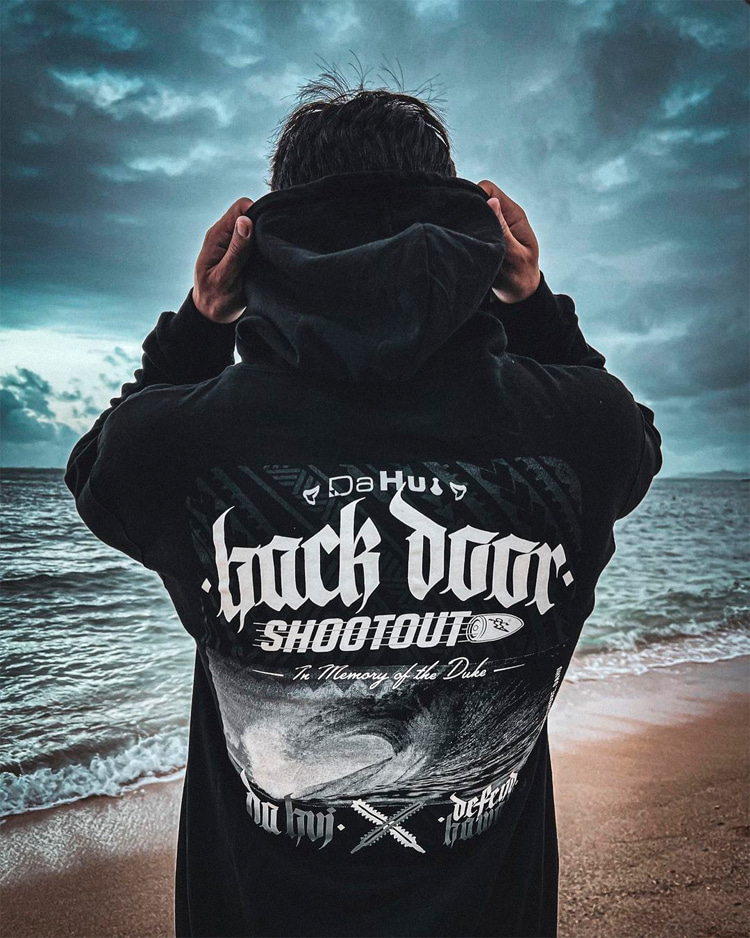
Da Hui Backdoor Shootout: an alternative and anti-establishment surf contest | Photo: Da Hui

An Alternative, Anti-Establishment Event

Therefore, the Da Hui/Hui O He'e Nalu Backdoor Shootout highlights the classic Hawaiian surfing approach, focusing on style, strength, and reverence for the sea.

Participants are evaluated based on their technical skills, general strategy, choice of waves, and proficiency in tube riding, emerging with poise and flair.

The contest features shortboard, longboard, stand-up paddleboarding, and bodysurfing divisions.

Although not as prestigious and old as the Pipeline Masters - a contest founded and nurtured by the mainstream surf industry - the Backdoor Shootout holds a famed reputation.

The specialty invitational event often features some of the world's best Banzai Pipeline tube-riding experts.

It only runs when the conditions at the legendary North Shore of Oahu surf break shine in all its glory.

Each competitor is part of a team that is only announced moments before the start of the competition.

The judging scale does not follow the industry standard. Waves are scored from 0 to 12.

The event format has remained unchanged since its creation in 1996, and the live webcast is usually free from all the regular surf culture clichés and normalized commentaries.

Hawaiian Pidgin is the official language of the broadcast.

The contest in memory of Duke Kahanamoku is held every year in January with a tight waiting period.


por Surf News | Headlines and Top Stories https://ift.tt/y5CN02h

Postagens mais visitadas deste blog

Duke Kahanamoku reflects on surfing, Olympics, and old Hawaii in 1966 interview

Duke Kahanamoku is the most influential surfer of all time and is often hailed as the father of modern surfing. There is nearly no one questioning these titles. Recently, Public Broadcasting Service (PBS) Hawaii unveiled a never-before-seen interview with the legendary surfer and Olympic swimmer. In the 1966 episode of Pau Hana Years, a seminal Hawaii television program that aired on KHET-TV (now PBS Hawaii) for 16 years, running from 1966 until 1982, Bob Barker chats with Duke Kahanamoku, then 76. The conversation drifts from royal ancestry to Olympic lanes, from Hollywood sets to a surfboard shaped by hand, tracing the outline of a life that helped define modern surfing and Hawaii's public image in the 20th century. And if you know little about the man who dreamed of getting surfing into the Olympic Games, this is a precious piece of history. A name with history, worn casually The interview starts with Kahanamoku explaining that "Duke" is not a title but his giv...

The hydrodynamics of surfboard fins

Have you ever wondered why a surfboard fin looks like that? It is a single or a set of fixed blades or keels located under a board, near the tail, often no bigger than a hand. Yet that small surface is where much of the surfboard's behavior takes place. Speed, hold, looseness, and the feeling of control all trace back to how water moves around fins. The physics of surfboard fins falls under hydrodynamics, the study of how fluids behave in motion. So, according to science, they feature a shape designed to turn flowing water into several forces. Let's take a look at what's at stake when fins and water interact. Lift and the feeling of control One of the key variables in hydrodynamic terms involving surfboard fins is lift. When a surfer leans into a turn, the board tilts and the fins meet the water at an angle. The angle is enough to create a pressure difference between the two sides of the fin. Water speeds up on one side and slows on the other. The result is a sidewa...

How paddleboarding transforms your body and mind

Adventure is on our doorstep. With so many different bodies of water available to paddleboarders, from city canals to coastal routes, we can find adventure in places much closer to home than people might initially expect. According to the Canal and River Trust, 50 percent of people in England and Wales live within just eight kilometers of a canal or river, and eight million people live less than one kilometer away. I had lived within just a few kilometers of the Leeds and Liverpool Canal for years and never really explored it before stand-up paddleboarding (SUP) came into my life . The challenge created both a new perspective and a deeper love for where I lived and the areas which I passed through. On my coast-to-coast journey, I slept in my own bed for two nights as the route passed through my then hometown of Skipton, yet I felt I was on a grand journey of discovery. We are braver, stronger, and more resilient than we think. SUP not only helps us feel more connected to our va...