Pular para o conteúdo principal

Carissa Moore leaves competitive surfing

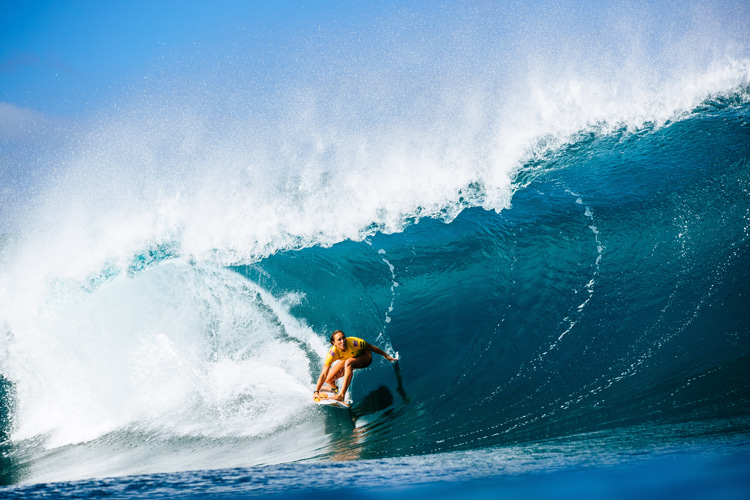
Carissa Moore: the most successful Hawaiian competitive female surfer of all time | Photo: WSL

Five-time world champion Carissa Moore announced that she will be stepping away from competitive surfing to start a new chapter in her life and career.

The 31-year-old from the South Shore of Oahu will compete on home soil in the Pipe Pro before withdrawing from the Championship Tour (CT) and will receive the wildcard to compete in the Tahiti Pro.

She will then compete in the Paris 2024 Olympic Games before taking some personal time away from competition.

A born competitor who always brings her A-game and has showcased her greatness on the CT since 2010, Moore is opting to step away from that aspect of her life and career.

At the forefront of surfing's progression for years, the Hawaiian has decided to challenge herself outside of the jersey following the Olympic Games. 

"I'm excited to see what else there is, outside the jersey," Moore said.

"I don't like the word retirement. I like to say a departure from the tour, or just stepping back, or switching gears, or, like, evolving."

A two-time runner-up and the defending event winner at Pipeline, Moore will enjoy the opportunity to celebrate an incredibly successful career with the North Shore community and her fans at the Pipe Pro.

Her track record in Hawaii with five event wins, including one as a wildcard before even stepping onto the CT, makes her an absolute favorite. 

Surfing's first Olympic gold medalist at the 2020 Tokyo Olympic Games, Moore will also look to defend her medal at the Paris 2024 Olympics held in Tahiti this summer.

She reached the Quarterfinals twice at Teahupoo on the CT and will receive a wildcard into this year's event as she continues to build experience and hone her skills in one of the world's most treacherous lineups ahead of the Olympic Games.

"As Carissa Moore shares her decision of this new chapter, we reflect on her incredible journey and the profound impact she's had on surfing," Jessi Miley-Dyer, WSL Chief of Sport, said.

"She is a champion and a role model in and out of the water. Throughout her career, Carissa has exemplified grace, resilience, and competitive excellence."

"Her achievements have transcended the sport, bringing a new level of athleticism and progression to surfing."

"Carissa's dedication to pushing the boundaries has been inspirational, and her absence in the competitive scene will be deeply felt." 

Looking Back: Moore's Record-Breaking Career in Numbers

Moore's incredible 13-year career is decorated with almost every professional surfing accolade possible, including five world titles and surfing's first Olympic gold medal.

Moore has competed in 120 Championship Tour events, claiming 28 event wins throughout her career. 

Moore arrived on the Championship Tour in 2010, posing an immediate threat to her competition.

In her first year on Tour, she finished third overall and was named Rookie of the Year.

The following season, she claimed her first world title at just 18 years old, becoming the youngest man or woman ever to do so. Moore undoubtedly ushered in a new era of power surfing to the CT. 

Moore embodies the Aloha spirit and created the Moore Aloha Foundation to inspire the next generation of young surfers.

She is truly a trailblazer in the sport and will continue to push the progression of surfing in her new chapter. 


por Surf News | Headlines and Top Stories https://ift.tt/HXliTPJ

Postagens mais visitadas deste blog

Duke Kahanamoku reflects on surfing, Olympics, and old Hawaii in 1966 interview

Duke Kahanamoku is the most influential surfer of all time and is often hailed as the father of modern surfing. There is nearly no one questioning these titles. Recently, Public Broadcasting Service (PBS) Hawaii unveiled a never-before-seen interview with the legendary surfer and Olympic swimmer. In the 1966 episode of Pau Hana Years, a seminal Hawaii television program that aired on KHET-TV (now PBS Hawaii) for 16 years, running from 1966 until 1982, Bob Barker chats with Duke Kahanamoku, then 76. The conversation drifts from royal ancestry to Olympic lanes, from Hollywood sets to a surfboard shaped by hand, tracing the outline of a life that helped define modern surfing and Hawaii's public image in the 20th century. And if you know little about the man who dreamed of getting surfing into the Olympic Games, this is a precious piece of history. A name with history, worn casually The interview starts with Kahanamoku explaining that "Duke" is not a title but his giv...

The hydrodynamics of surfboard fins

Have you ever wondered why a surfboard fin looks like that? It is a single or a set of fixed blades or keels located under a board, near the tail, often no bigger than a hand. Yet that small surface is where much of the surfboard's behavior takes place. Speed, hold, looseness, and the feeling of control all trace back to how water moves around fins. The physics of surfboard fins falls under hydrodynamics, the study of how fluids behave in motion. So, according to science, they feature a shape designed to turn flowing water into several forces. Let's take a look at what's at stake when fins and water interact. Lift and the feeling of control One of the key variables in hydrodynamic terms involving surfboard fins is lift. When a surfer leans into a turn, the board tilts and the fins meet the water at an angle. The angle is enough to create a pressure difference between the two sides of the fin. Water speeds up on one side and slows on the other. The result is a sidewa...

How paddleboarding transforms your body and mind

Adventure is on our doorstep. With so many different bodies of water available to paddleboarders, from city canals to coastal routes, we can find adventure in places much closer to home than people might initially expect. According to the Canal and River Trust, 50 percent of people in England and Wales live within just eight kilometers of a canal or river, and eight million people live less than one kilometer away. I had lived within just a few kilometers of the Leeds and Liverpool Canal for years and never really explored it before stand-up paddleboarding (SUP) came into my life . The challenge created both a new perspective and a deeper love for where I lived and the areas which I passed through. On my coast-to-coast journey, I slept in my own bed for two nights as the route passed through my then hometown of Skipton, yet I felt I was on a grand journey of discovery. We are braver, stronger, and more resilient than we think. SUP not only helps us feel more connected to our va...