Pular para o conteúdo principal

Glitter biodegradável prejudica meio ambiente tanto quanto versão comum, aponta estudo

'Se você usar glitter, limpe e jogue no lixo em vez de lavar com água', diz cientista
‘Se você usar glitter, limpe e jogue no lixo em vez de lavar com água’, diz cientista Reuters

O glitter biodegradável também gera prejuízos ao meio ambiente, assim como o glitter comum, segundo um estudo realizado no Reino Unido.

A procura pela versão ecológica desse produto, que é bastante popular no Carnaval, aumentou após cientistas apontarem que as pequenas partículas de plástico brilhantes da versão original chegam aos rios e mares por meio do sistema de esgoto e levam anos para se degradar.

No entanto, a pesquisa feita pela Universidade Anglia Ruskin, em Cambridge, e publicada no Journal of Hazardous Materials indica que a alternativa biodegradável também é prejudicial ao meio ambiente.

Como seu glitter no Carnaval chega aos peixes no Oceano

O problema pouco conhecido do plástico biodegradável

O glitter tradicional consiste em um núcleo de plástico feito de um filme poliéster PET, que é revestido com alumínio e, em seguida, coberto com outra fina camada de plástico.

Com a denúncias sobre seu impacto ambiental, foram criadas versões biodegradáveis. Uma delas tem um núcleo de celulose, revestido com alumínio para refletividade e coberto com uma fina camada de plástico. Outra é o glitter de mica, um tipo de mineral cada vez mais utilizado em cosméticos.

Em testes feitos em laboratório, todos os tipos de glitter afetaram o crescimento das plantas e algas de um lago.

“O glitter é um tipo de microplástico e pode ter os mesmos efeitos que outros microplásticos e não deve ser lançado em grandes quantidades no meio ambiente”, diz Dannielle Green, professora sênior de Biologia na Universidade Anglia Ruskin, à BBC News.

“Se você está usando como maquiagem, seria sensato limpá-lo e colocá-lo no lixo ao invés de lavá-lo com água.”

Como foi feita a pesquisa
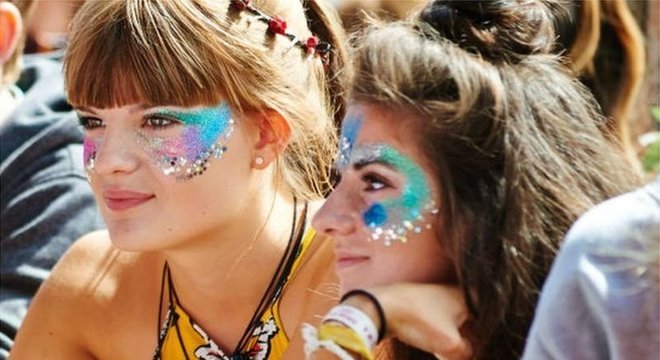
Todos os tipos de glitter geraram prejuízos ao meio ambiente, segundo pesquisa britânica
Todos os tipos de glitter geraram prejuízos ao meio ambiente, segundo pesquisa britânica Getty Images

De acordo com os pesquisadores, este é o primeiro estudo a avaliar o impacto ambiental do glitter em corpos d'água.

Para testar esses efeitos, os pesquisadores coletaram água, sedimentos e plantas do rio Glaven, em Norfolk.

Eles criaram lagos em miniatura no laboratório, nos quais lançaram seis tipos diferentes de glitter. Todos diminuíram a abundância de plantas comuns, bem como de algas microscópicas. Não houve diferença significativa entre os efeitos das versões ecológicas e tradicionais.

O glitter biodegradável também dobrou a presença de caramujos não nativos, que normalmente encontrados em águas poluídas. Segundo os cientistas, isso pode gerar a interrupções na cadeia alimentar de um ecossistema.

Os experimentos testaram os efeitos de grandes quantidades de purpurina, semelhante a quando o glitter é usado por um grande número de pessoas ao mesmo tempo.

Os cientistas dizem ser menos preocupante os efeitos de quantidades menores, como as usadas na maquiagem.

O impacto em plantas e caramujos foi observado após 36 dias. O estudo não avaliou o impacto no longo prazo.


Este texto foi publicado primeiro em http://noticias.r7.com/tecnologia-e-ciencia/glitter-biodegradavel-prejudica-meio-ambiente-tanto-quanto-versao-comum-aponta-estudo-15102020

Via RSS publicado em https://vitorolig.tumblr.com/post/632085286722076672

Postagens mais visitadas deste blog

Duke Kahanamoku reflects on surfing, Olympics, and old Hawaii in 1966 interview

Duke Kahanamoku is the most influential surfer of all time and is often hailed as the father of modern surfing. There is nearly no one questioning these titles. Recently, Public Broadcasting Service (PBS) Hawaii unveiled a never-before-seen interview with the legendary surfer and Olympic swimmer. In the 1966 episode of Pau Hana Years, a seminal Hawaii television program that aired on KHET-TV (now PBS Hawaii) for 16 years, running from 1966 until 1982, Bob Barker chats with Duke Kahanamoku, then 76. The conversation drifts from royal ancestry to Olympic lanes, from Hollywood sets to a surfboard shaped by hand, tracing the outline of a life that helped define modern surfing and Hawaii's public image in the 20th century. And if you know little about the man who dreamed of getting surfing into the Olympic Games, this is a precious piece of history. A name with history, worn casually The interview starts with Kahanamoku explaining that "Duke" is not a title but his giv...

The hydrodynamics of surfboard fins

Have you ever wondered why a surfboard fin looks like that? It is a single or a set of fixed blades or keels located under a board, near the tail, often no bigger than a hand. Yet that small surface is where much of the surfboard's behavior takes place. Speed, hold, looseness, and the feeling of control all trace back to how water moves around fins. The physics of surfboard fins falls under hydrodynamics, the study of how fluids behave in motion. So, according to science, they feature a shape designed to turn flowing water into several forces. Let's take a look at what's at stake when fins and water interact. Lift and the feeling of control One of the key variables in hydrodynamic terms involving surfboard fins is lift. When a surfer leans into a turn, the board tilts and the fins meet the water at an angle. The angle is enough to create a pressure difference between the two sides of the fin. Water speeds up on one side and slows on the other. The result is a sidewa...

How paddleboarding transforms your body and mind

Adventure is on our doorstep. With so many different bodies of water available to paddleboarders, from city canals to coastal routes, we can find adventure in places much closer to home than people might initially expect. According to the Canal and River Trust, 50 percent of people in England and Wales live within just eight kilometers of a canal or river, and eight million people live less than one kilometer away. I had lived within just a few kilometers of the Leeds and Liverpool Canal for years and never really explored it before stand-up paddleboarding (SUP) came into my life . The challenge created both a new perspective and a deeper love for where I lived and the areas which I passed through. On my coast-to-coast journey, I slept in my own bed for two nights as the route passed through my then hometown of Skipton, yet I felt I was on a grand journey of discovery. We are braver, stronger, and more resilient than we think. SUP not only helps us feel more connected to our va...