Pular para o conteúdo principal

A quase colisão de dois pedaços de lixo espacial observada de perto por radar

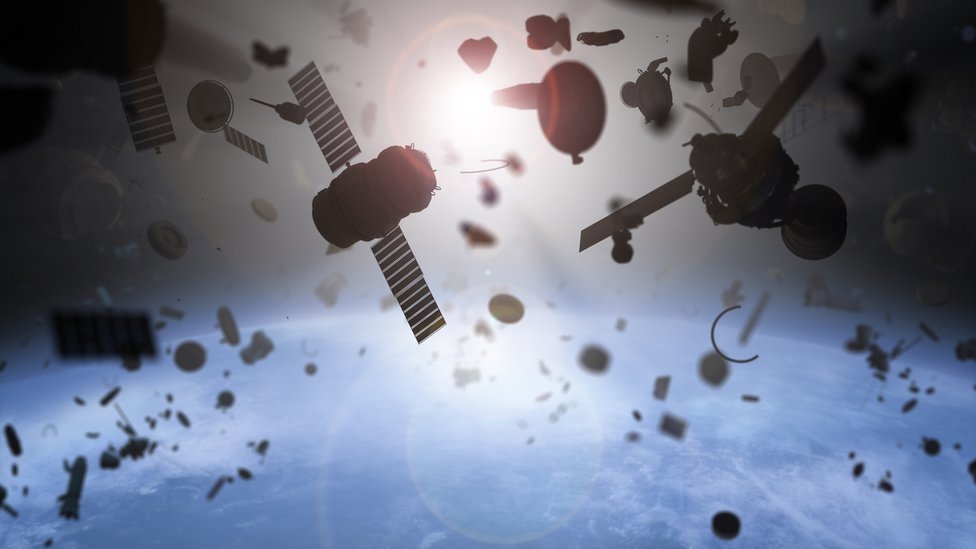
Aumenta preocupação entre especialistas sobre riscos causados por crescente lixo no espaço
Aumenta preocupação entre especialistas sobre riscos causados por crescente lixo no espaço Getty Images/BBC NEWS BRASIL

Dois pedaços de lixo espacial que deveriam bem perto um do outro escaparam de uma colisão, disse uma empresa que usa radar para rastrear objetos em órbita.

A LeoLabs disse que um satélite russo desativado e um segmento de foguete chinês descartado provavelmente ficarão a 25 metros um do outro.

Segundo a empresa, não havia sinais de destroços sobre a Antártica na manhã desta sexta-feira, 16 de outubro.

Outros especialistas estimaram que o Kosmos-2004 e o estágio de foguete ChangZheng passariam com uma distância muito maior.

Como os objetos têm uma massa combinada de mais de 2,5 toneladas e velocidade relativa de 14,66 km/s (32.800 mph), qualquer colisão teria sido catastrófica e produzido uma chuva de destroços.

E dada a altitude de quase mil km, fragmentos resultantes teriam permanecido em órbita por um tempo extremamente longo, representando uma ameaça aos satélites operacionais.

A LeoLabs, uma start-up do Vale do Silício, oferece serviços de mapeamento orbital usando sua própria rede de radar.

Moriba Jah, astrodinamicista da Universidade do Texas em Austin, nos Estados Unidos, calculou a distância entre os dois objetos como sendo de 70 m.

E a Aerospace Corporation, uma consultoria altamente respeitada, chegou a uma conclusão semelhante.

Com mais e mais satélites sendo lançados, há uma preocupação crescente sobre o potencial de colisões.

A grande preocupação é a crescente população de hardware redundante em órbita — cerca de 900 mil objetos maiores que 1 cm em algumas contagens —, todos eles capazes de causar danos imensos, ou até mesmo destruir, uma espaçonave operacional em um encontro de alta velocidade.

Nesta semana, a Agência Espacial Europeia divulgou o seu relatório anual sobre o estado do ambiente espacial, destacando o problema contínuo dos eventos de fragmentação.

Isso inclui explosões em órbita causadas por sobras de energia — em combustível e baterias — a bordo de antigas espaçonaves e foguetes.

Em média, nas últimas duas décadas, 12 fragmentações acidentais ocorreram no espaço a cada ano, “e essa tendência infelizmente está aumentando”, disse a agência.

Também nesta semana, no Congresso Internacional de Astronáutica online, um grupo de especialistas, listou o que considerou como os 50 objetos abandonados em órbita mais preocupantes.

Uma grande proporção deles eram antigos estágios de foguetes Zenit russos ou dos tempos da União Soviética.


Este texto foi publicado primeiro em http://noticias.r7.com/tecnologia-e-ciencia/a-quase-colisao-de-dois-pedacos-de-lixo-espacial-observada-de-perto-por-radar-16102020

Via RSS publicado em https://vitorolig.tumblr.com/post/632168315162411008

Postagens mais visitadas deste blog

Duke Kahanamoku reflects on surfing, Olympics, and old Hawaii in 1966 interview

Duke Kahanamoku is the most influential surfer of all time and is often hailed as the father of modern surfing. There is nearly no one questioning these titles. Recently, Public Broadcasting Service (PBS) Hawaii unveiled a never-before-seen interview with the legendary surfer and Olympic swimmer. In the 1966 episode of Pau Hana Years, a seminal Hawaii television program that aired on KHET-TV (now PBS Hawaii) for 16 years, running from 1966 until 1982, Bob Barker chats with Duke Kahanamoku, then 76. The conversation drifts from royal ancestry to Olympic lanes, from Hollywood sets to a surfboard shaped by hand, tracing the outline of a life that helped define modern surfing and Hawaii's public image in the 20th century. And if you know little about the man who dreamed of getting surfing into the Olympic Games, this is a precious piece of history. A name with history, worn casually The interview starts with Kahanamoku explaining that "Duke" is not a title but his giv...

The hydrodynamics of surfboard fins

Have you ever wondered why a surfboard fin looks like that? It is a single or a set of fixed blades or keels located under a board, near the tail, often no bigger than a hand. Yet that small surface is where much of the surfboard's behavior takes place. Speed, hold, looseness, and the feeling of control all trace back to how water moves around fins. The physics of surfboard fins falls under hydrodynamics, the study of how fluids behave in motion. So, according to science, they feature a shape designed to turn flowing water into several forces. Let's take a look at what's at stake when fins and water interact. Lift and the feeling of control One of the key variables in hydrodynamic terms involving surfboard fins is lift. When a surfer leans into a turn, the board tilts and the fins meet the water at an angle. The angle is enough to create a pressure difference between the two sides of the fin. Water speeds up on one side and slows on the other. The result is a sidewa...

How paddleboarding transforms your body and mind

Adventure is on our doorstep. With so many different bodies of water available to paddleboarders, from city canals to coastal routes, we can find adventure in places much closer to home than people might initially expect. According to the Canal and River Trust, 50 percent of people in England and Wales live within just eight kilometers of a canal or river, and eight million people live less than one kilometer away. I had lived within just a few kilometers of the Leeds and Liverpool Canal for years and never really explored it before stand-up paddleboarding (SUP) came into my life . The challenge created both a new perspective and a deeper love for where I lived and the areas which I passed through. On my coast-to-coast journey, I slept in my own bed for two nights as the route passed through my then hometown of Skipton, yet I felt I was on a grand journey of discovery. We are braver, stronger, and more resilient than we think. SUP not only helps us feel more connected to our va...