Pular para o conteúdo principal

Satélite descobre um dos mais quentes e extremos exoplanetas

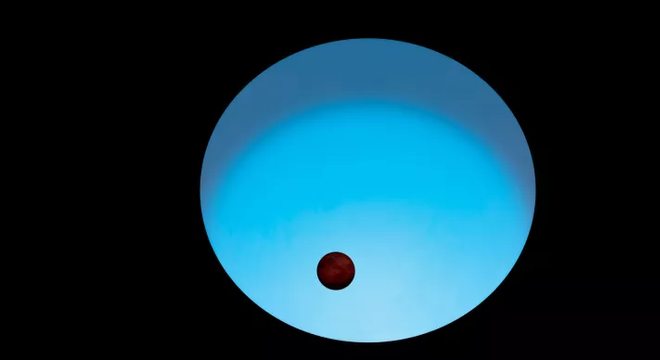
Uma ilustração do planeta WASP-189 b em contraste com sua estrela
Uma ilustração do planeta WASP-189 b em contraste com sua estrela ESA

A Agência Espacial Europeia descobriu a existência de um dos mais quentes e extremos exoplanetas, ou planetas extrassolares – isto é, que orbitam em torno de uma estrela diferente do Sol – conhecidos até o momento: o WASP-189 b.

A descoberta, divulgada nesta segunda-feira (28), está entre os primeiros resultados da Cheops (sigla para Characterizing exoplanet satellite – em português, Satélite caracterizador de exoplanetas), que tem como missão caracterizar exoplanetas ao redor de estrelas próximas.

Segundo a agência espacial, o WASP-189 b é considerado um “Júpiter quente”. Isso porque o planeta é composto de gáses assim como Júpiter, mas tem uma órbita muito próxima de sua estrela – cerca de 20 vezes mais perto do que a Terra está do Sol –, levando a atingir temperaturas de até 3.200º C, capazes de derreter metais, como ferro, e transformá-los em gás.

Os cientistas observaram também que a estrela na qual o exoplaneta orbita tem um brilho azulado, é maior do que o Sol e também cerca de 2 mil graus mais quente. Além disso, o corpo celeste tem um formato peculiar.

“Notamos algo interessante na sua estrela, que não é perfeitamente redonda, mas mais larga e menos quente no seu equador do que nos polos, o que os torna mais brilhantes”, afirmou a astrofísica Monika Lendi, da Universidade de Genebra, em comunicado.

A esperança é que estudar este sistema extremo com suas órbitas inclinadas, giro agitado e relacionamento superaquecido ajude os pesquisadores a entender melhor “Júpiteres quentes” e outros exoplanetas, levando-os a novos insights sobre o planeta Terra e seu papel no universo maior.

*Estagiária do R7 sob supervisão de Pablo Marques


Este texto foi publicado primeiro em http://noticias.r7.com/tecnologia-e-ciencia/satelite-descobre-um-dos-mais-quentes-e-extremos-exoplanetas-28092020

Via RSS publicado em https://vitorolig.tumblr.com/post/630533788709044224

Postagens mais visitadas deste blog

Duke Kahanamoku reflects on surfing, Olympics, and old Hawaii in 1966 interview

Duke Kahanamoku is the most influential surfer of all time and is often hailed as the father of modern surfing. There is nearly no one questioning these titles. Recently, Public Broadcasting Service (PBS) Hawaii unveiled a never-before-seen interview with the legendary surfer and Olympic swimmer. In the 1966 episode of Pau Hana Years, a seminal Hawaii television program that aired on KHET-TV (now PBS Hawaii) for 16 years, running from 1966 until 1982, Bob Barker chats with Duke Kahanamoku, then 76. The conversation drifts from royal ancestry to Olympic lanes, from Hollywood sets to a surfboard shaped by hand, tracing the outline of a life that helped define modern surfing and Hawaii's public image in the 20th century. And if you know little about the man who dreamed of getting surfing into the Olympic Games, this is a precious piece of history. A name with history, worn casually The interview starts with Kahanamoku explaining that "Duke" is not a title but his giv...

King Haakon VIII of Norway and his lifelong love of surfing

When Haakon VIII became King of Norway on August 28, 2026, the world learned more about the man behind the crown. Former Crown Prince Haakon is a sailor, skier, outdoor enthusiast, and, perhaps most surprisingly for a European monarch, a committed surfer. Nevertheless, he's not the first. Charles III , King of England, has surfed before, as have previous British royals . But let's focus on the newly crowned Norwegian king who has already spent years chasing waves. Haakon surfed in California while studying at the University of California, Berkeley, and later returned to the water in Norway with his family. The Nordic royal helped bring the European Surfing Championships (Eurosurf) to Norway and watched his daughter compete in the sport. Then, in a 2023 interview with Norwegian broadcaster NRK, he revealed how serious his surfing ambitions might once have been. Are you curious already? Let's see how surfing conquered Haakon VIII. A royal discovers surfing in Californ...

The hydrodynamics of surfboard fins

Have you ever wondered why a surfboard fin looks like that? It is a single or a set of fixed blades or keels located under a board, near the tail, often no bigger than a hand. Yet that small surface is where much of the surfboard's behavior takes place. Speed, hold, looseness, and the feeling of control all trace back to how water moves around fins. The physics of surfboard fins falls under hydrodynamics, the study of how fluids behave in motion. So, according to science, they feature a shape designed to turn flowing water into several forces. Let's take a look at what's at stake when fins and water interact. Lift and the feeling of control One of the key variables in hydrodynamic terms involving surfboard fins is lift. When a surfer leans into a turn, the board tilts and the fins meet the water at an angle. The angle is enough to create a pressure difference between the two sides of the fin. Water speeds up on one side and slows on the other. The result is a sidewa...