Pular para o conteúdo principal

O leite de vaca feito sem vacas

undefined
undefined Science Photo Library

Em uma medida que pode melhorar as credenciais verdes da indústria de laticínios, um pequeno laboratório está produzindo leite real a partir de células sem precisar pisar em uma fazenda. Mas a agricultura celular pode substituir a produção tradicional de leite?

A indústria de laticínios que conhecemos hoje é, na minha opinião, ambientalmente insustentável. A produção de leite sozinha contribui com 4% das emissões totais de gases de efeito estufa da atividade humana — cerca de 2 bilhões de toneladas de CO2 por ano.

No geral, 37% das emissões globais de metano vêm da produção de gado. O metano é um gás de efeito estufa muito potente — cerca de 25 vezes mais eficaz na captura de radiação do que o CO2. Os laticínios também consomem uma grande quantidade de recursos, como terra e água.

Isso não pode continuar, especialmente se quisermos alimentar outro bilhão de pessoas neste planeta. Precisamos desenvolver novas tecnologias que possam nos fornecer os mesmos produtos dos quais gostamos tanto — leite, queijo, creme e manteiga — mas que sejam menos poluentes. Esse é o nosso objetivo no TurtleTree Labs.

O que podemos fazer é criar leite cru usando células de mamíferos, cultivando essas células em nosso laboratório e estimulando-as a produzir leite em biorreatores gigantes. As células grudam em canudos minúsculos, o fluido é então puxado pelos canudos e o leite sai pela outra extremidade.

Somos a primeira empresa no mundo a usar células para criar leite cru. É emocionante pensar que esses biorreatores poderiam ser implantados em qualquer lugar do mundo onde houvesse uma crise ou uma grande necessidade de leite e começar a produzir imediatamente.
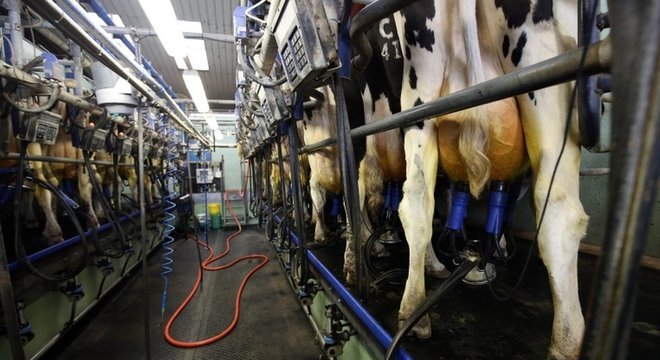
Tirando leite de vacas
Tirando leite de vacas PA Media

Também estamos animados para ver o que podemos fazer com nosso leite produzido em laboratório. Até agora, tivemos sucesso com células de vacas, cabras, ovelhas e camelos, o que significa que as possibilidades são enormes. Ainda mais novidades virão quando começarmos a fazer queijos e manteigas com este leite também.

Já vimos outras empresas fazerem algo muito semelhante com a carne. E os consumidores estão cada vez mais pressionando por produtos livres de crueldade. Eles estão mais conscientes de como reduzir suas emissões de gases de efeito estufa. Ao extrair o leite das células em nosso laboratório, podemos obter leite de verdade sem ter que prejudicar o planeta e os animais, então este é o futuro.

Esta entrevista com Max Rye, estrategista-chefe do TurtleTree Labs, foi filmada e produzida por Nyima Pratten.

Este artigo é parte do Follow the Food, uma série que investiga como a agricultura está respondendo aos desafios ambientais. O Follow the Food rastreia as respostas emergentes para esses problemas — tanto de alta e baixa tecnologia, locais e globais — de agricultores, produtores e pesquisadores nos seis continentes.


Este texto foi publicado primeiro em http://noticias.r7.com/tecnologia-e-ciencia/o-leite-de-vaca-feito-sem-vacas-31082020

Via RSS publicado em https://vitorolig.tumblr.com/post/627985758899339264

Postagens mais visitadas deste blog

Duke Kahanamoku reflects on surfing, Olympics, and old Hawaii in 1966 interview

Duke Kahanamoku is the most influential surfer of all time and is often hailed as the father of modern surfing. There is nearly no one questioning these titles. Recently, Public Broadcasting Service (PBS) Hawaii unveiled a never-before-seen interview with the legendary surfer and Olympic swimmer. In the 1966 episode of Pau Hana Years, a seminal Hawaii television program that aired on KHET-TV (now PBS Hawaii) for 16 years, running from 1966 until 1982, Bob Barker chats with Duke Kahanamoku, then 76. The conversation drifts from royal ancestry to Olympic lanes, from Hollywood sets to a surfboard shaped by hand, tracing the outline of a life that helped define modern surfing and Hawaii's public image in the 20th century. And if you know little about the man who dreamed of getting surfing into the Olympic Games, this is a precious piece of history. A name with history, worn casually The interview starts with Kahanamoku explaining that "Duke" is not a title but his giv...

The hydrodynamics of surfboard fins

Have you ever wondered why a surfboard fin looks like that? It is a single or a set of fixed blades or keels located under a board, near the tail, often no bigger than a hand. Yet that small surface is where much of the surfboard's behavior takes place. Speed, hold, looseness, and the feeling of control all trace back to how water moves around fins. The physics of surfboard fins falls under hydrodynamics, the study of how fluids behave in motion. So, according to science, they feature a shape designed to turn flowing water into several forces. Let's take a look at what's at stake when fins and water interact. Lift and the feeling of control One of the key variables in hydrodynamic terms involving surfboard fins is lift. When a surfer leans into a turn, the board tilts and the fins meet the water at an angle. The angle is enough to create a pressure difference between the two sides of the fin. Water speeds up on one side and slows on the other. The result is a sidewa...

How paddleboarding transforms your body and mind

Adventure is on our doorstep. With so many different bodies of water available to paddleboarders, from city canals to coastal routes, we can find adventure in places much closer to home than people might initially expect. According to the Canal and River Trust, 50 percent of people in England and Wales live within just eight kilometers of a canal or river, and eight million people live less than one kilometer away. I had lived within just a few kilometers of the Leeds and Liverpool Canal for years and never really explored it before stand-up paddleboarding (SUP) came into my life . The challenge created both a new perspective and a deeper love for where I lived and the areas which I passed through. On my coast-to-coast journey, I slept in my own bed for two nights as the route passed through my then hometown of Skipton, yet I felt I was on a grand journey of discovery. We are braver, stronger, and more resilient than we think. SUP not only helps us feel more connected to our va...