Pular para o conteúdo principal

Post de Trump no Twitter é escondido por 'glorificar violência'

Reprodução / Twitter

O Twitter ocultou um post do presidente dos EUA, Donald Trump, por violar as regras de conduta da rede social ao “glorificar a violência”. No tuíte, o líder norte-americano comenta as manifestações em Minneapolis, provocadas pelo assassinato de George Floyd, um homem negro, por um policial branco, e sugere atirar contra os manifestantes.

O post não foi excluído da rede, mas apenas ocultado com um aviso padrão: “Este Tweet violou as Regras do Twitter sobre enaltecimento da violência. No entanto, o Twitter determinou que pode ser de interesse público que esse Tweet continue acessível.”

A determinação do Twitter ocorre poucas horas depois de Trump assinar uma ordem executiva que ameaça as redes socias com novos regulamentos sobre liberdade de expressão. O presidente dos EUA acusa as megaempresas do Vale do Silício — Twitter e Facebook, em especial — de usarem os seus serviços de verificação de fatos para, supostamente, censurar vozes conservadoras.

Não há provas a este respeito. Até o momento, nenhuma das várias investigações em curso sobre o funcionamento das redes sociais apontou qualquer viés desfavorável ao que Trump chama de “vozes conservadoras”, em geral, grupos de direita, ultradireita e nacionalistas que estão na sua base de apoio.
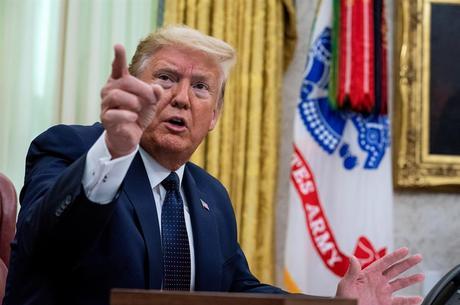
Tuíte de Trump remete a outros incidentens raciais
Trump, após assinar decreto sobre redes sociais
Trump, após assinar decreto sobre redes sociais Doug Mills / Pool via EFE-EPA - 28.5.2020


A frase usada por Trump no post — “quando os saques começam, os tiros começam” — espelha uma expressão semelhante usada por um delegado de polícia durante protestos motivados por questões raciais nos anos 1960, em Miami. De acordo com a rede de TV CNN, historiadores e lideranças sociais e políticas condenaram o uso da expressão.

“… Esses bandidos estão desonrando a memória de George Floyd, e eu não deixarei isso acontecer. Acabei de falar com o governador Tim Walz e lhe disse que os militares estão com ele o tempo todo. Qualquer dificuldade e assumiremos o controle, mas, quando o saque começa, o tiroteio começa. Obrigado!”, diz o tuíte, que ainda pode ser lido após um clique extra sobre o post.

Trump divulgou seu tweet depois de dias de inquietação em Minneapolis, onde comícios pacíficos deram lugar a uma terceira noite de protestos, saques e incêndios, numa expressão da raiva da população pela morte de George Floyd, um homem negro que foi sufocado até a morte por um policial branco após ser acusado de usar uma nota falsa de 20 dólares em uma loja.

A ação policial foi gravada em vídeo. O oficial aparece ajoelhada sobre o pescoço de Floyd, que diz “não consigo respirar, vou morrer” várias vezes antes de desfalecer.

Quatro policiais envolvidos na morte de Floyd foram demitidos e o FBI está investigando.


Este texto foi publicado primeiro em http://noticias.r7.com/tecnologia-e-ciencia/post-de-trump-no-twitter-e-escondido-por-glorificar-violencia-29052020

Via RSS publicado em https://vitorolig.tumblr.com/post/619484729148850176

Postagens mais visitadas deste blog

Duke Kahanamoku reflects on surfing, Olympics, and old Hawaii in 1966 interview

Duke Kahanamoku is the most influential surfer of all time and is often hailed as the father of modern surfing. There is nearly no one questioning these titles. Recently, Public Broadcasting Service (PBS) Hawaii unveiled a never-before-seen interview with the legendary surfer and Olympic swimmer. In the 1966 episode of Pau Hana Years, a seminal Hawaii television program that aired on KHET-TV (now PBS Hawaii) for 16 years, running from 1966 until 1982, Bob Barker chats with Duke Kahanamoku, then 76. The conversation drifts from royal ancestry to Olympic lanes, from Hollywood sets to a surfboard shaped by hand, tracing the outline of a life that helped define modern surfing and Hawaii's public image in the 20th century. And if you know little about the man who dreamed of getting surfing into the Olympic Games, this is a precious piece of history. A name with history, worn casually The interview starts with Kahanamoku explaining that "Duke" is not a title but his giv...

King Haakon VIII of Norway and his lifelong love of surfing

When Haakon VIII became King of Norway on August 28, 2026, the world learned more about the man behind the crown. Former Crown Prince Haakon is a sailor, skier, outdoor enthusiast, and, perhaps most surprisingly for a European monarch, a committed surfer. Nevertheless, he's not the first. Charles III , King of England, has surfed before, as have previous British royals . But let's focus on the newly crowned Norwegian king who has already spent years chasing waves. Haakon surfed in California while studying at the University of California, Berkeley, and later returned to the water in Norway with his family. The Nordic royal helped bring the European Surfing Championships (Eurosurf) to Norway and watched his daughter compete in the sport. Then, in a 2023 interview with Norwegian broadcaster NRK, he revealed how serious his surfing ambitions might once have been. Are you curious already? Let's see how surfing conquered Haakon VIII. A royal discovers surfing in Californ...

The hydrodynamics of surfboard fins

Have you ever wondered why a surfboard fin looks like that? It is a single or a set of fixed blades or keels located under a board, near the tail, often no bigger than a hand. Yet that small surface is where much of the surfboard's behavior takes place. Speed, hold, looseness, and the feeling of control all trace back to how water moves around fins. The physics of surfboard fins falls under hydrodynamics, the study of how fluids behave in motion. So, according to science, they feature a shape designed to turn flowing water into several forces. Let's take a look at what's at stake when fins and water interact. Lift and the feeling of control One of the key variables in hydrodynamic terms involving surfboard fins is lift. When a surfer leans into a turn, the board tilts and the fins meet the water at an angle. The angle is enough to create a pressure difference between the two sides of the fin. Water speeds up on one side and slows on the other. The result is a sidewa...