Pular para o conteúdo principal

Pesquisadores da USP criam teste de covid-19 usando peixe paulistinha 

Teste custa 5 vezes menos do que os utilizados no momento
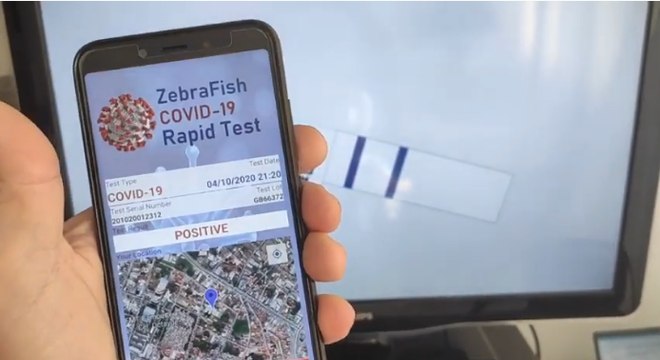
Teste custa 5 vezes menos do que os utilizados no momento Divulgação/ Jornal da USP

Pesquisadores brasileiros da Universidade de São Paulo, USP, desenvolveram um método um tanto inusitado para identificar a contaminação por covid-19. A tecnologia usa uma fita diagnóstica com um QR code que, ao ser lido por um aplicativo, fornece rapidamente o resultado – positivo ou negativo – para coronavírus.

Eles utilizaram os peixes paulistinha, ou zebrafish, como é chamado no exterior, como máquina de teste. Ao invés de detectar o vírus por uma máquina ou reagente químico, eles colocaram uma proteína do novo coronavírus no peixe e esperaram a reação.

“Conseguimos com a professora Cristiane Carvalho, que trabalha em conjunto com os professores Edison Durigon, ambos do ICB, e Shaker Chuck Farah, do Instituto de Química da USP, diferentes fragmentos de uma proteína do novo coronavírus chamada spike. Nós a injetamos no Zebrafish e isolamos os anticorpos dos ovos”, contou ao Jornal da USP Ives Charlie.

Esses anticorpos produzidos pelo peixe então são reproduzidos, isolados e colocados em fitas com códigos QR Code, que podem ser acessados pelo celular e dizem qual é o diagnóstico do paciente.

Os pesquisadores desenvolveram um projeto para um hackathon, uma espécie de maratona científica, para buscar soluções para a pandemia de covid-19. O resultado foi o quarto lugar entre mais de 40 equipes participantes do mundo todo. Confira como funciona:


Economia e praticidade


Os testes mostram que o preço é cinco vezes menor do que os testes rápidos. Além disso, pode ser utilizado em casa e tira a necessidade de ir até um hospital.

O aplicativo ainda o monitoramento por georreferenciamento que tiver teste positivo para o novo coronavírus. A ideia dos pesquisadores é que os órgãos de saúde pública também sejam notificados. 

“Um dos nossos diferenciais é este: o governo ou uma agência sanitária será informada. Hoje, o Ministério da Saúde tem que ficar ligando para as pessoas com sinais clínicos da doença. No aplicativo, a pessoa mesma pode ir informando”, ressaltou Ives Charlie ao jornal da USP.

Veja também: 

Saiba como decidir qual o melhor local para trabalhar em casa


Este texto foi publicado primeiro em http://noticias.r7.com/tecnologia-e-ciencia/pesquisadores-da-usp-criam-teste-de-covid-19-usando-peixe-paulistinha-29052020

Via RSS publicado em https://vitorolig.tumblr.com/post/619484730640957440

Postagens mais visitadas deste blog

Duke Kahanamoku reflects on surfing, Olympics, and old Hawaii in 1966 interview

Duke Kahanamoku is the most influential surfer of all time and is often hailed as the father of modern surfing. There is nearly no one questioning these titles. Recently, Public Broadcasting Service (PBS) Hawaii unveiled a never-before-seen interview with the legendary surfer and Olympic swimmer. In the 1966 episode of Pau Hana Years, a seminal Hawaii television program that aired on KHET-TV (now PBS Hawaii) for 16 years, running from 1966 until 1982, Bob Barker chats with Duke Kahanamoku, then 76. The conversation drifts from royal ancestry to Olympic lanes, from Hollywood sets to a surfboard shaped by hand, tracing the outline of a life that helped define modern surfing and Hawaii's public image in the 20th century. And if you know little about the man who dreamed of getting surfing into the Olympic Games, this is a precious piece of history. A name with history, worn casually The interview starts with Kahanamoku explaining that "Duke" is not a title but his giv...

The hydrodynamics of surfboard fins

Have you ever wondered why a surfboard fin looks like that? It is a single or a set of fixed blades or keels located under a board, near the tail, often no bigger than a hand. Yet that small surface is where much of the surfboard's behavior takes place. Speed, hold, looseness, and the feeling of control all trace back to how water moves around fins. The physics of surfboard fins falls under hydrodynamics, the study of how fluids behave in motion. So, according to science, they feature a shape designed to turn flowing water into several forces. Let's take a look at what's at stake when fins and water interact. Lift and the feeling of control One of the key variables in hydrodynamic terms involving surfboard fins is lift. When a surfer leans into a turn, the board tilts and the fins meet the water at an angle. The angle is enough to create a pressure difference between the two sides of the fin. Water speeds up on one side and slows on the other. The result is a sidewa...

How paddleboarding transforms your body and mind

Adventure is on our doorstep. With so many different bodies of water available to paddleboarders, from city canals to coastal routes, we can find adventure in places much closer to home than people might initially expect. According to the Canal and River Trust, 50 percent of people in England and Wales live within just eight kilometers of a canal or river, and eight million people live less than one kilometer away. I had lived within just a few kilometers of the Leeds and Liverpool Canal for years and never really explored it before stand-up paddleboarding (SUP) came into my life . The challenge created both a new perspective and a deeper love for where I lived and the areas which I passed through. On my coast-to-coast journey, I slept in my own bed for two nights as the route passed through my then hometown of Skipton, yet I felt I was on a grand journey of discovery. We are braver, stronger, and more resilient than we think. SUP not only helps us feel more connected to our va...