Pular para o conteúdo principal

Foto de Júpiter: a imagem extraordinária do planeta gigante que os astrônomos construíram com um mosaico de fotos
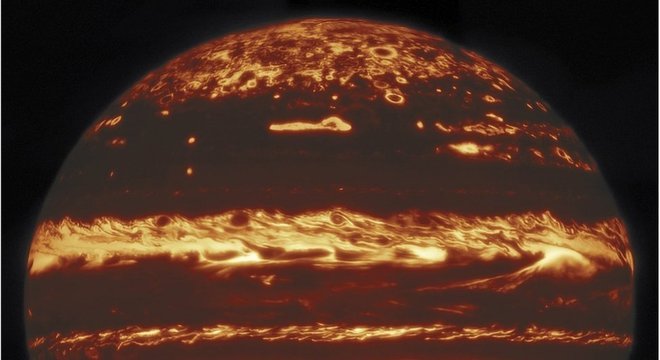
Foram necessárias centenas de exposições para criar esse nítido mosaico de imagens infravermelhas de Júpiter
Foram necessárias centenas de exposições para criar esse nítido mosaico de imagens infravermelhas de Júpiter Gemini Observatory/M.H.Wong et al /BBC NEWS BRASIL

Os astrônomos criaram uma nova imagem extraordinária de Júpiter, rastreando as regiões de calor que se encontram sob as gigantescas nuvens de gás do planeta vizinho.

A imagem foi obtida com o Telescópio Gemini North, localizado no Havaí, e é um dos avistamentos mais nítidos do planeta já obtidos na Terra.

Para alcançar essa resolução, os cientistas usaram uma técnica de alta resolução usada em astronomia chamada em inglês de lucky imaging, que envolve a geração e a combinação de imagens obtidas de várias exposições ultrarrápidas, minimizando os efeitos de turbulências na atmosfera na composição de uma única imagem final — um mosaico de fotos.

O estudo que produziu essa imagem infravermelha foi liderado por cientistas da Universidade da Califórnia, em Berkeley.
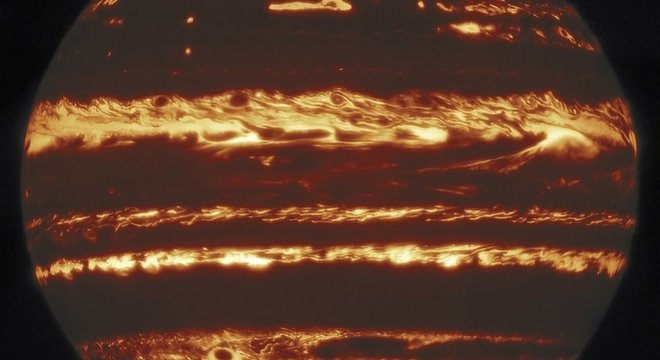
 As regiões de calor abaixo das nuvens de gás foram definidas com muitos detalhes na imagem
As regiões de calor abaixo das nuvens de gás foram definidas com muitos detalhes na imagem Gemini Observatory/M.H.Wong et al/BBC NEWS BRASIL

Ele foi parte de um programa conjunto de observações que envolveram o telescópio Hubble e da sonda espacial Juno, que atualmente orbita Júpiter.

O infravermelho tem um comprimento de onda maior que a luz visível obtida pelo Hubble.

É usado para ver além da neblina e nuvens no topo da atmosfera de Júpiter, dando aos cientistas a oportunidade de observar o planeta gigante mais de perto.
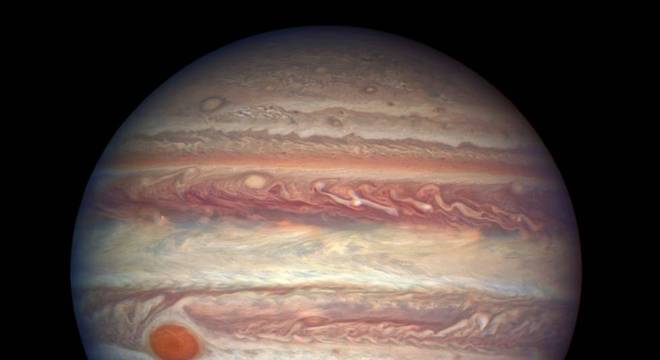
 Esta é uma foto de Júpiter tirada pelo Telescópio Espacial Hubble
Esta é uma foto de Júpiter tirada pelo Telescópio Espacial Hubble NASA/ESA/A.Simon/BBC NEWS BRASIL

Os pesquisadores buscam entender melhor como os sistemas climáticos da gigante de gás são gerados e mantidos, e em particular as grandes tempestades que podem ser desencadeadas por décadas e até séculos.

Alguns dados sobre Júpiter:

— Júpiter tem um diâmetro 11 vezes maior que a Terra e é 300 vezes maior.

— Leva 12 anos terrestres para dar uma volta em torno do Sol, e um “dia” nesse planeta dura 10 horas.

— Sua composição é semelhante à de uma estrela, com hidrogênio e hélio como seus principais elementos.

— Quando o hidrogênio está sob pressão, ele se transforma em um estado semelhante ao metal

— Esse “hidrogênio metálico” pode ser a fonte do campo magnético do planeta.

— A maioria das nuvens visíveis contém amônia e sulfeto de hidrogênio.

— As faixas de baixa latitude de Júpiter abrigam fortes ventos na direção leste-oeste.

— A Grande Mancha Vermelha é um vórtice gigante de tempestade maior que a Terra.


Este texto foi publicado primeiro em http://noticias.r7.com/tecnologia-e-ciencia/foto-de-jupiter-a-imagem-extraordinaria-do-planeta-gigante-que-os-astronomos-construiram-com-um-mosaico-de-fotos-11052020

Via RSS publicado em https://vitorolig.tumblr.com/post/617853367530799104

Postagens mais visitadas deste blog

Duke Kahanamoku reflects on surfing, Olympics, and old Hawaii in 1966 interview

Duke Kahanamoku is the most influential surfer of all time and is often hailed as the father of modern surfing. There is nearly no one questioning these titles. Recently, Public Broadcasting Service (PBS) Hawaii unveiled a never-before-seen interview with the legendary surfer and Olympic swimmer. In the 1966 episode of Pau Hana Years, a seminal Hawaii television program that aired on KHET-TV (now PBS Hawaii) for 16 years, running from 1966 until 1982, Bob Barker chats with Duke Kahanamoku, then 76. The conversation drifts from royal ancestry to Olympic lanes, from Hollywood sets to a surfboard shaped by hand, tracing the outline of a life that helped define modern surfing and Hawaii's public image in the 20th century. And if you know little about the man who dreamed of getting surfing into the Olympic Games, this is a precious piece of history. A name with history, worn casually The interview starts with Kahanamoku explaining that "Duke" is not a title but his giv...

The hydrodynamics of surfboard fins

Have you ever wondered why a surfboard fin looks like that? It is a single or a set of fixed blades or keels located under a board, near the tail, often no bigger than a hand. Yet that small surface is where much of the surfboard's behavior takes place. Speed, hold, looseness, and the feeling of control all trace back to how water moves around fins. The physics of surfboard fins falls under hydrodynamics, the study of how fluids behave in motion. So, according to science, they feature a shape designed to turn flowing water into several forces. Let's take a look at what's at stake when fins and water interact. Lift and the feeling of control One of the key variables in hydrodynamic terms involving surfboard fins is lift. When a surfer leans into a turn, the board tilts and the fins meet the water at an angle. The angle is enough to create a pressure difference between the two sides of the fin. Water speeds up on one side and slows on the other. The result is a sidewa...

How paddleboarding transforms your body and mind

Adventure is on our doorstep. With so many different bodies of water available to paddleboarders, from city canals to coastal routes, we can find adventure in places much closer to home than people might initially expect. According to the Canal and River Trust, 50 percent of people in England and Wales live within just eight kilometers of a canal or river, and eight million people live less than one kilometer away. I had lived within just a few kilometers of the Leeds and Liverpool Canal for years and never really explored it before stand-up paddleboarding (SUP) came into my life . The challenge created both a new perspective and a deeper love for where I lived and the areas which I passed through. On my coast-to-coast journey, I slept in my own bed for two nights as the route passed through my then hometown of Skipton, yet I felt I was on a grand journey of discovery. We are braver, stronger, and more resilient than we think. SUP not only helps us feel more connected to our va...