Pular para o conteúdo principal

É possível produzir anticorpos contra a covid-19, aponta estudo

Teste ainda precisa ser explorado em humanos
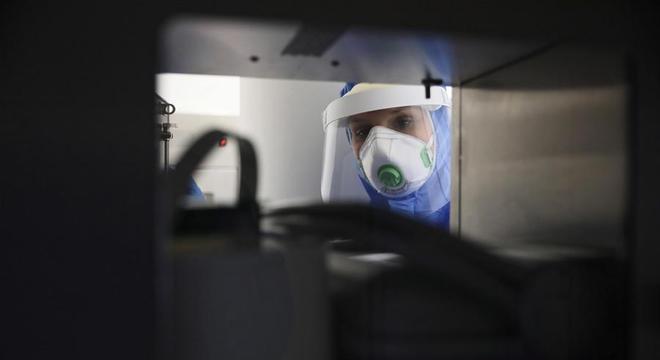
Teste ainda precisa ser explorado em humanos Leszek Szymansk / EFE - EPA - 14.5.2020

Um entendimento da proteção imune daqueles que já foram expostos à covid-19 é essencial para a criação de uma vacina e organização da saúde pública rumo ao fim da pandemia.

Uma nova pesquisa utilizando macacos, publicada em nesta quarta-feira (20) pela revista Science, mostra que a infecção por coronavírus induziu, por meio do organismo, a proteção necessária para evitar a recontaminação. Ou seja, ficaram imunes e não foram contaminados novamente.

Para obter os resultados, os pesquisadores infectaram 9 macacos com doses do vírus. Como esperado, todos foram contaminados e passaram a reproduzir o vírus no corpo. Alguns tiveram sintomas e outros não, mas nenhum morreu.

Após 35 dias, a mesma quantidade de vírus foi injetada nos mesmos 9 macacos, mas com resultados diferentes. Nenhum ou quase nenhum vírus foi encontrado em seus sistemas após um dia, e, esse pouco resíduo de covid-19 encontrado foi o mesmo injetado.

Assim, é possível afirmar que o corpo não produziu o vírus, portanto não foi infectado.

O que isso significa

Existe uma preocupação muito grande quanto a capacidade do corpo em produzir anticorpos contra vírus específicos. Alguns, como o HIV, não tem. Portanto, o resultado é essencial para provar que o organismo é capaz de produzir anticorpos contra a covid-19.

Ainda não é possível definir com certeza que o corpo humano tem os mesmos resultados, mas os macacos são escolhidos para fazer os testes por questões de proximidade fisiológica com o nosso corpo. Os testes terão que avançar em humanos para definir se o mesmo se aplica.

Como o teste é recente, não é possível afirmar quanto tempo durarão esses anticorpos, os macacos continuaram sob supervisão para análise.

*Estagiário sob supervisão de Deborah Giannini

Veja também: 

Sete hábitos para adotar na quarentena e levar pra vida


Este texto foi publicado primeiro em http://noticias.r7.com/tecnologia-e-ciencia/e-possivel-produzir-anticorpos-contra-a-covid-19-aponta-estudo-20052020

Via RSS publicado em https://vitorolig.tumblr.com/post/618699566626242560

Postagens mais visitadas deste blog

Duke Kahanamoku reflects on surfing, Olympics, and old Hawaii in 1966 interview

Duke Kahanamoku is the most influential surfer of all time and is often hailed as the father of modern surfing. There is nearly no one questioning these titles. Recently, Public Broadcasting Service (PBS) Hawaii unveiled a never-before-seen interview with the legendary surfer and Olympic swimmer. In the 1966 episode of Pau Hana Years, a seminal Hawaii television program that aired on KHET-TV (now PBS Hawaii) for 16 years, running from 1966 until 1982, Bob Barker chats with Duke Kahanamoku, then 76. The conversation drifts from royal ancestry to Olympic lanes, from Hollywood sets to a surfboard shaped by hand, tracing the outline of a life that helped define modern surfing and Hawaii's public image in the 20th century. And if you know little about the man who dreamed of getting surfing into the Olympic Games, this is a precious piece of history. A name with history, worn casually The interview starts with Kahanamoku explaining that "Duke" is not a title but his giv...

The hydrodynamics of surfboard fins

Have you ever wondered why a surfboard fin looks like that? It is a single or a set of fixed blades or keels located under a board, near the tail, often no bigger than a hand. Yet that small surface is where much of the surfboard's behavior takes place. Speed, hold, looseness, and the feeling of control all trace back to how water moves around fins. The physics of surfboard fins falls under hydrodynamics, the study of how fluids behave in motion. So, according to science, they feature a shape designed to turn flowing water into several forces. Let's take a look at what's at stake when fins and water interact. Lift and the feeling of control One of the key variables in hydrodynamic terms involving surfboard fins is lift. When a surfer leans into a turn, the board tilts and the fins meet the water at an angle. The angle is enough to create a pressure difference between the two sides of the fin. Water speeds up on one side and slows on the other. The result is a sidewa...

How paddleboarding transforms your body and mind

Adventure is on our doorstep. With so many different bodies of water available to paddleboarders, from city canals to coastal routes, we can find adventure in places much closer to home than people might initially expect. According to the Canal and River Trust, 50 percent of people in England and Wales live within just eight kilometers of a canal or river, and eight million people live less than one kilometer away. I had lived within just a few kilometers of the Leeds and Liverpool Canal for years and never really explored it before stand-up paddleboarding (SUP) came into my life . The challenge created both a new perspective and a deeper love for where I lived and the areas which I passed through. On my coast-to-coast journey, I slept in my own bed for two nights as the route passed through my then hometown of Skipton, yet I felt I was on a grand journey of discovery. We are braver, stronger, and more resilient than we think. SUP not only helps us feel more connected to our va...